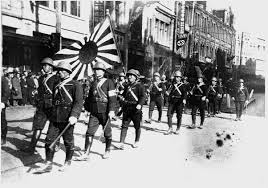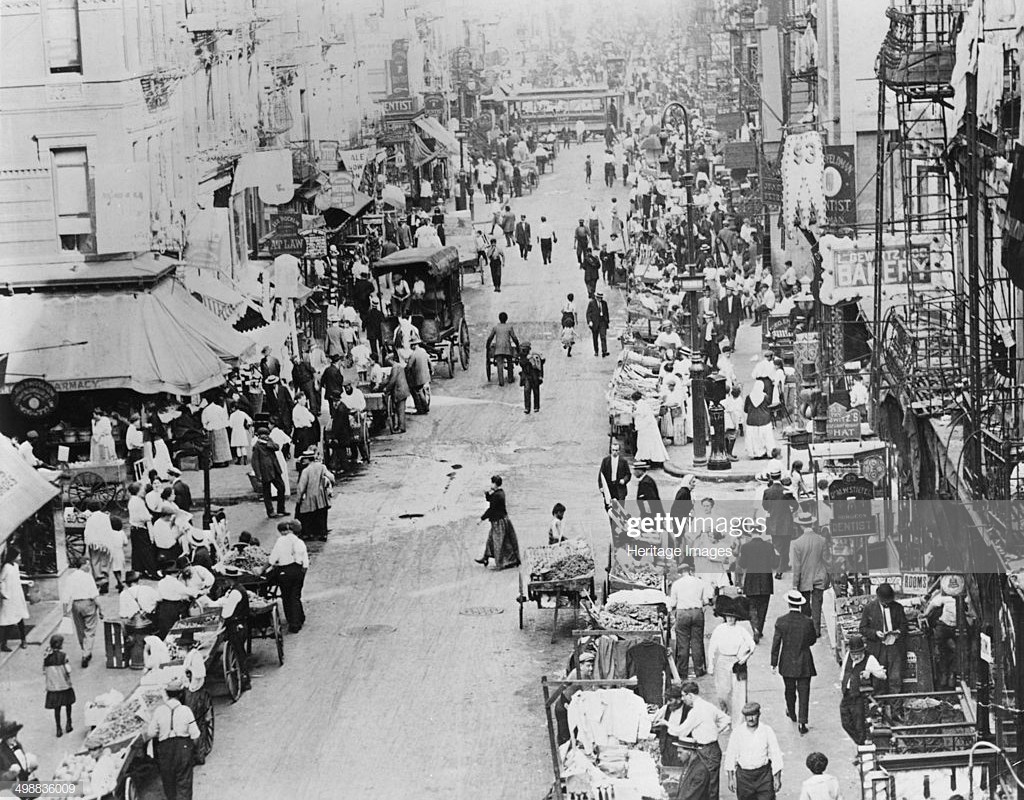
Alvina: Earliest Memories

-By Alivina Chimenti Damis

When my father Nicholas came of age at 23, he went back to Lungro in Calabria, Italy to marry my mother, Mary Alessio.  The marriage was planned by the families.  My grandfather wanted a good match for his son, and the Alessio family was well regarded, though poor. My mother was only sixteen but she had received a good education and was already working as a schoolteacher.  After the wedding in Lungro, Papa brought Mama to America along with her six-year-old brother, Giacobbe (Jacob), who she raised as a son. It was 1889.

Initially, my parents lived with my grandparents at St. James Place. When my brother Jimmy was born in 1890, my parents moved to Mott Street, directly opposite Chinatown. (In those days, Chinatown was only four square blocks — Pell Street, Doyers Street, Mott Street, and Park Row.)  I was born in 1894 and my parents named me Alvina after my maternal grandmother.  With three kids in the house now, my parents moved again, this time to an apartment on Canal Street.
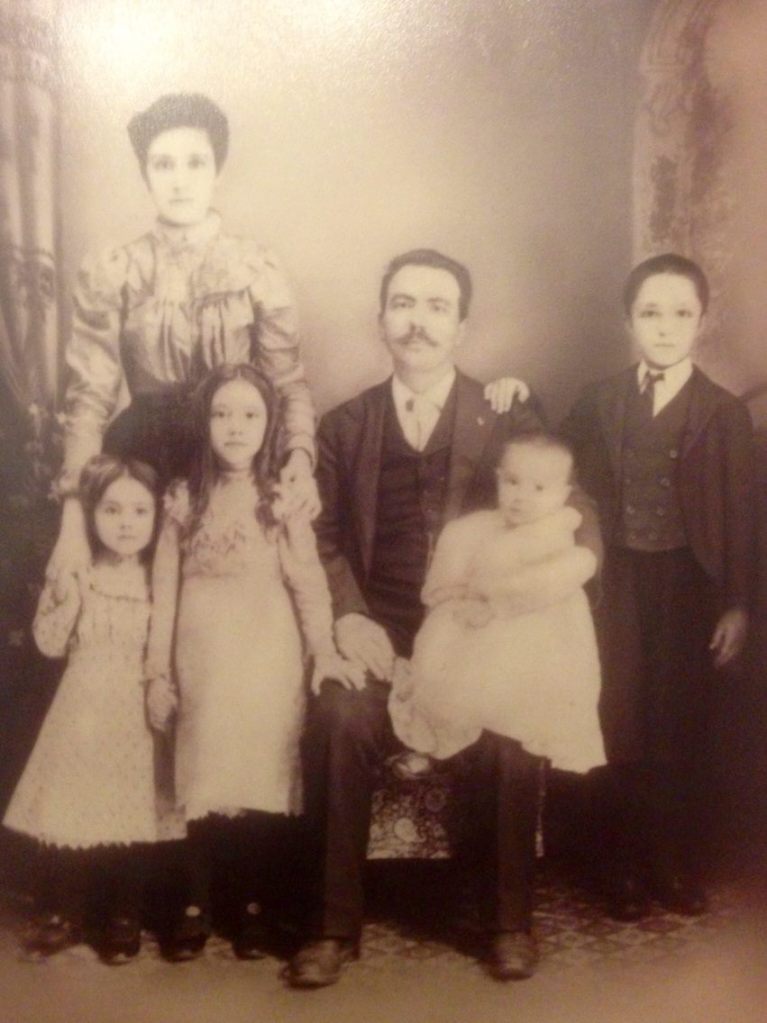
Mary and Nicholas Damis, with (left to right) Elizabeth, Alvina (author), Peter, and Jimmy

The apartments back then weren’t anything like they are today. For starters, the house was always cold, especially at night. The only source of heat was the kitchen range, heated by wood or coal if you could afford it.

Mama eventually had six more children: Peter, Elizabeth (Lizzie), Matilda (Tillie), Anna, Jack, and baby Mildred Carmella. There was always so much work to do. I remember Aunt Katie warming Cousin Georgie’s socks in the oven so he would put them on nice and toasty in the morning.  My brothers and sisters used to laugh at him and poke fun because Mama didn’t have time to cater to us like that.

Once a week, on Saturday night, we had to take baths.  My mother would put a tub of warm water on the kitchen floor and one at a time, the kids would bathe. There was a kettle of water constantly on the kitchen range, so we could warm up the water as needed. When we went to bed a night, my mother heated water in a bottle, put the water in a jug, and put the jug into our beds to warm them up before we got into them.  

Then, there was the weekly clothes wash.  On Monday, Mama would first have to heat the water, then put it into two tubs–one for white clothes and one for colors.  She would soak the clothes overnight and next morning rub them one by one on a washboard, then put then on a large boiler on top of the stove.  This would boil all morning until the clothes were clean to Mama’s satisfaction.  Then she would rinse them two or three times in cold water and hang them out on a long wire to dry in the sun and wind.

In addition to finishing the laundry, we ironed on Tuesday, which was by itself an all-day chore.  Wednesday we mended and darned (socks included). Thursday was cleaning house day, and Friday was for shopping (a loaf of bread was two cents, a pound of butter five cents, and eggs were eight cents a dozen). Saturday was baking and cooking all day long.

Sunday was my favorite day.  The whole family would go to church in our Sunday clothes, which were reserved for this day of the week. My father was a tailor, like his father, and because of this our clothes were always impeccable.  After church, company would come over for dinner.  The little children would go out and play for a few hours and older ones would take a walk and end up buying an ice-cream soda.  It was only five cents, but it was a luxury.

I grew up in the candlelight era. At dusk, the lamp lighter came around with a wand lighting up the lamp posts.  The lamps always looked so pretty when they were lit up, especially if there had been a snowstorm. The snow and ice looked like diamonds.

In our apartment, we carried candles from room to room to light the way.  These candles cast shadows as we walked into the dark rooms, and sometimes it was scary. I remember a Jewish family who lived in our neighborhood. Every Friday evening at sundown, I would drop whatever I was doing and go to their house to light up all the candles in their home.  They paid me ten cents a week!

There were so many people who used to have fires because of the candles.  One family we knew, the Christies, were completely burned out of their home.  It was bitter cold with ice and snow on the ground on Christmas Day. The Christies had small candles on their Christmas tree and the whole tree went afire.  Their curtains caught fire and before the fire engine arrived (which was drawn by horses), they were completely burned out.

The neighbors all got busy.  They took the family into their homes, clothed and fed them, and put up beds for them until they could get on their own again.  My mother, who was always ready to help whenever there was trouble, gave away clothing and food.  One bitter cold day my father was going out to work and when he went to get his coat, he learned Mama had given it to Mr. Christie.  Poor Papa had to go without.

When kerosene lamps came into usage, everybody welcomed them.  If you wanted the lamps to glow brightly, though, they had to be kept clean.  We would take them apart every day, fill up the glass bottoms with kerosene, put a new wick in them and shine the glass globe that went on top.

After a few years the city had gas pipes put in underground and we were very happy that we were going to have gas light.  Gradually, gas stoves were installed and gas water heaters so that we could have hot water when we wanted it.  No more heating water on the stove to take baths and wash clothes.  Of course, the broilers were not connected with the gas stoves, and we had to light the pilot light located at the bottom of the stove.  But, we were happy.

Later, we had wash tubs installed in our kitchens, and bathtubs, and private toilets. No more scary trips to the backyard to use the toilet! Each time these improvements were made, rents would go up but then wages would rise, so we were glad to pay these higher rates. According to what I remember, when I got married in 1915, I got a beautiful apartment in a two-family house for fifteen dollars a month.

Remembering my childhood on Canal Street brings happy memories.  When we moved there, four family houses stood in a row, over stores. Canal Street was a thoroughfare, and horse drawn trolleys went from the East Side to the West. The West Side was separated from the East Side by another wide thoroughfare, Broadway.  The West Side was used for industry and extended all the way down to the river, where large ships came from all over the world with imports and exports.  The East Side extended from Broadway to Delancey Street, and beyond that started the Uptown District.

All us kids attended Public School 23 on Mulberry School.  There were children of all nationalities, and we got along well. I was good with languages and learned how to speak a little German and Yiddish (of course I also spoke English and my parents’ Calabrian-Italian dialect). After school, we played on the streets of New York City.  We liked to jump rope, play tag, and all sorts of other games.  The organ grinder with a monkey came around once a day.  Oh how we waited for him!  We would follow the organ grinder for blocks as his monkey, who was tied to the organ by a long string, would go around with a tin cup to all the storekeepers who would put a few pennies in his cup.

Sometimes, we would go over to Chinatown and buy Lychee Nuts.  They were two for a penny and fortune cookies were a penny a piece.  On the 4th of July, we went to Chinatown to buy firecrackers, a penny a piece. Although our neighborhood bordered Chinatown (and has since become a part of it), it seemed to us kids that the Chinese stayed within their own territory.  They were peculiar to us — they wore their hair in long pigtails down their backs, wore sandals all the time, and smoked from long pipes.  Once a city social worker disappeared in Chinatown.  Her disappearance was never solved.
Alvina: The Beginning

By Alvina Damis Chimenti

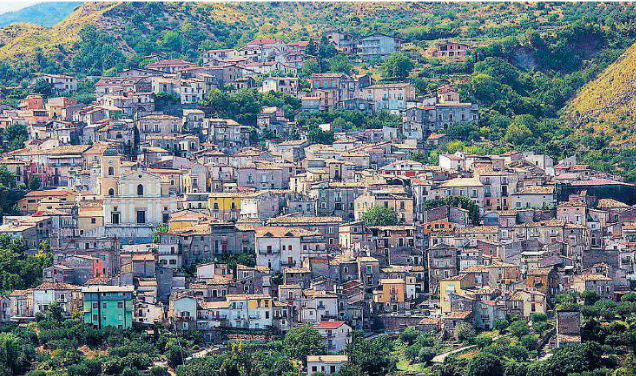
The first documents regarding Albania date from the fifteenth century, I believe. According to these documents, Albanians are descendants of the ancient Thracians and Illyrians. Many years ago, our ancestors migrated from Albania to the Calabria region of what today would be considered southern Italy – the “toe” of the boot. They settled in the small town of Lungro where they mingled with and married native Italians.  

My grandfather Gennaro Damis and my grandmother, whose maiden name was Elizabeth Balzano, were married in Lungro around 1865. They had four children together: Nicholas, Mary, Raquel (Katie), and Letizia (Elizabeth). I am sorry to say that they may have had several other children who did not survive beyond infancy, but I do not know more about this.

During the process of Risorgimento, or “unification” of Italy, life had become very difficult for the people of southern Italy, and many Italians had to make the difficult decision to leave their homes in search of better opportunities for their families. Gennaro and Elizabeth, together with their children, left Lungro for New York in the spring of 1886.

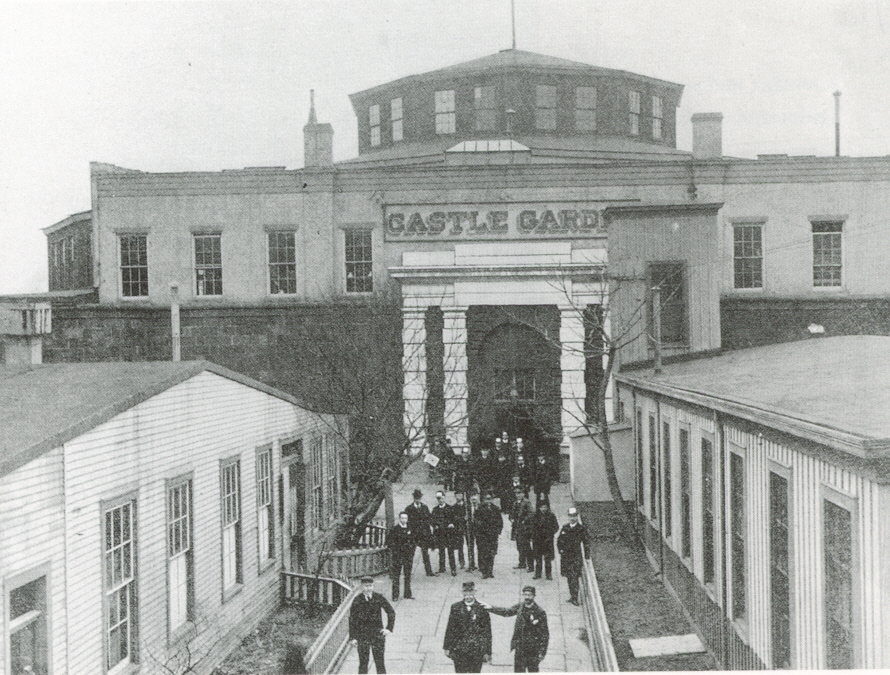
The Ellis Island Emigrant Processing Center had not yet been built when my family arrived.  At that time, new immigrants arriving in New York were taken instead to Castle Garden for processing.  Castle Garden was a fort that had been built around the time of the War of 1812, and I understand it was a miserable place.  

Castle Gardens Processing Center

My grandfather was asked if he had a trade (he did; he was a fine tailor), and whether he had a place to live.  Fortunately, a few friends of my grandparents who had come to America previously came to vouch for the family, so my grandparents were released immediately. Some poor immigrants who knew nobody had to stay on the island indefinitely, and sometimes they were even send back to their native lands.  My family, however, was welcomed into their friends’ home while they searched for work and a place to live.

According to my father, the family arrived in Manhattan on the day a big celebration was taking place.  There were banners flying, bands playing, and people gathered in the streets. My father told me of a man named John, who landed on the same day that he did.  He was crossing the street when a team of runaway horses came tearing down the street.  Someone shouted, “Look out, Johnny!” and pushed him out of the way.  He couldn’t understand how the man knew his name and said, “What smart people there are in America!”  I don’t think this story was true, but my father always chuckled when he told it.

My grandparents soon found an apartment on St. James Place, near Chatham Square. Gennaro got a job with an exclusive clothing establishment known as Levy & Son, which sold clothing for men and boys.  It was a high-class store and my grandfather was so proud to be paid with cash, unlike in the old country, where he would have traded for services.

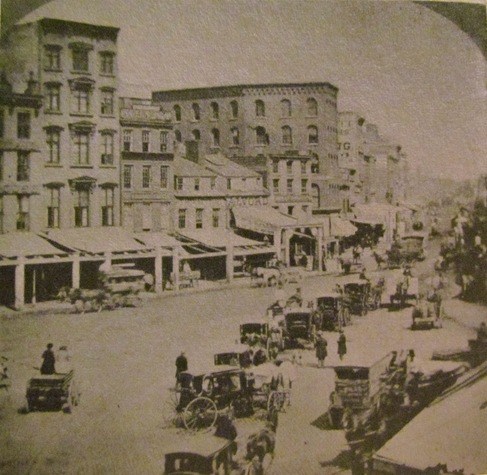
St. James Place, circa 1900’s

Shortly after arriving in New York, my Aunt Mary came of age at 16. She married John Frega, who worked as a street cleaner for the Sanitation Department.  The men wore heavy while uniforms which they had to keep spotless and they had to keep the streets immaculate.  John earned fifteen dollars a week and considered himself well-paid.  Mary and John had sixteen children, but only five survived.  It seemed the little babies could not live beyond their second birthday.

Aunt Katie married a politician named George Capparelli. They had only one child, Georgie. Uncle George was a member of a Democratic club know as Tammany Hall. He was a clever operator who earned his living issuing citizenship papers to poor ignorant immigrants and charged them a fortune. Of course, these papers were illegal and the government eventually caught up with him. He was convicted and sentenced to a year in Sing Sing Prison in 1899.

Uncle George did not stay in prison very long, however.  While in prison, he wrote to the Governor of New York, Theodore Roosevelt, and asked for a pardon.  After a few weeks, he was released and sent home.  From that day on, George became a Republican and campaigned very hard among the Italian people getting their votes for Roosevelt, who was running for President of the United States.

Elizabeth went into the convent at the age of fifteen, joining the Missionary Sisters of the Sacred Heart of Jesus, of which Mother Frances Cabrini was the Mother Superior.  Mother Cabrini worked tirelessly building schools, hospitals, and orphanages from New York to Chicago and Elizabeth, who had taken the name of Sister (later, Mother) Berchmans, traveled with Mother Cabrini everywhere she went.  

After an epidemic of smallpox took the lives of a number of nuns in New York, Mother Cabrini wanted a burial place just for the nuns.  She solicited money from the wealthier immigrant families of New York.  My grandfather (who was hardly a “wealthy immigrant”) donated a thousand dollars — an astronomical sum — towards this goal.  

Eventually, Mother Cabrini was able to buy a beautiful piece of property in upstate New York, overlooking the Hudson River.  It was known as West Park Cemetery and it exists today, although the property has expanded into a discernment center for women curious about taking Orders. Mother Cabrini has been canonized by the Roman Catholic Church as the Patron Saint of Immigrants.

When my father came of age at 23, he went back to Calabria to marry my mother, Mary Alessio.  The marriage was planned by the families who had known each other in Lungro.  My grandfather wanted a good match for his son, and although the Alessio family was poor, they were well regarded within the community. My mother was only sixteen but she had received a good education and was already working as a schoolteacher.

After the wedding in Lungro, Papa brought Mama to America. They traveled in steerage class aboard the brand-new SS Augusta Victoria. The newlyweds brought Mary’s six-year-old brother, Giacobbe along with them. Once they landed in New York, Giacobbe became Jacob. It was 1889.

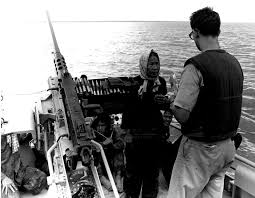
RARE Film Footage: On Board A Market Time Cutter (1965-1966)

This remarkable short film recounts the start of Operation Market Time in 1965 from the perspective of the inaugural members of Coast Guard Squadron One’s Divisions 11 and 12. This film has it all: SERE training with the Marines in Alameda, transport of the Cutters across the rocky South China Sea from the Philippines, and behind-the-scenes of actual vessel searches. Fascinating how the seasoned CO’s of the first combat year (many of whom were obviously WWII and Korea Vets) would give way to the much younger skippers in place by 1967.

Timeline of Vietnam Conflict

  • 1940-1945 — Leading up to and during World War II, Japan occupies Indochina, allowing the Vichy French government to retain nominal control over much of its former colonial territory, including Laos, Cambodia, and Vietnam.
  • 15 August 1945 — Japan unconditionally surrenders to Allied Powers, creating a massive power vacuum across the Asia-Pacific region.
  • 02 September 1945 — Japan signs the Japanese Instrument of Surrender, officially ending World War II. That same day, in the city of Hanoi, Ho Chí Minh declares Vietnamese independence, founding the communist Democratic Republic of Vietnam (DRV).
  • 19 December 1946 — The First Indochina War begins between the communist forces of the DRV and the French colonial interests seeking to retake their former colonies.
  • 01 May 1950 — U.S. President Harry Truman approves $10 million USD in military assistance to support anti-communist efforts in Indochina.
  • 26 April 1954 — The Geneva Conference is convened to resolve outstanding issues in Korea and ongoing hostilities in Indochina.
  • 7 May 1954 — The French are decisively defeated by the DRV at the Battle of Dien Bien Phu.
  • 20 July 1954 — Parties to the Geneva Conference agree to divide the country of Vietnam into two “zones” at the 17th Parallel: the northern Democratic Republic of Vietnam, and the southern State of Vietnam, led by Emperor Bao Dai. This division was intended to be temporary pending reunification elections that were to occur in 1956.
  • 1954 — Emperor Bao Dai asks Ngo Dinh Diem to serve as Prime Minister of the State of Vietnam.
  • 26 October 1955 — Prime Minister Diem deposes Emperor Bao Dai and declares himself President of the newly formed Republic of Vietnam (RVN).
  • 01 November 1955 — U.S. President Dwight D. Eisenhower deploys American servicemen as part of the Vietnam Military Assistance Advisory Group (MAAG) to train the Army of the Republic of Vietnam, This action is considered the official beginning of American involvement in the Vietnam war. During this time, the DRV engages in violent “anti-landlord” campaigns in the north, deposing landholders of property in a forced redistribution of wealth.
  • April 1956 — Last French troops leave Vietnam. The national unification elections planned for at the 1954 Geneva Conference fail to occur.
  • 08 June 1956 — Air Force T-Sgt. Richard B. Fitzgibbon Jr. becomes the first American war casualty when he is murdered by a fellow U.S. serviceman following an argument.
  • December 1958 — The DRV invades Laos. Laos would become an important part of the DRV’s logistics system, known to some as the Ho Chi Minh Trail, supplying goods, arms, and troops between the DRV and sympathetic forces in the Republic of Vietnam.
  • 20 December 1960 — The National Liberation Front of South Vietnam (Viet Cong) is formed by the DRV as an insurgency movement inside the Republic of Vietnam.
  • May 1961 — U.S. President John F. Kennedy, Jr. authorizes 500 Special Forces troops and military advisers to assist the Republic of Vietnam.
  • November 1961 — The United States Joint Chiefs of Staff directs Commander-in-Chief, Pacific (CINCPAC) to look into the RVN Navy’s poor performance against DRV infiltration.
  • 11 June 1963 — Buddhist monk Thich Quang Duc self-immolates in Saigon to protest RVN President Diem’s persecution of Buddhists.
  • 02 September 1963 — President Kennedy criticizes President Diệm in an interview with Walter Cronkite, citing his repression of Buddhists and claims that Diệm is out of touch with his countrymen.
  • 02 November 1963 — President Diem is assassinated in a military coup. Gen. Duong Van Minh, leading the Revolutionary Military Committee of the dissident generals who had conducted the coup, takes over leadership of RVN. A period of instability culminating in a series of military coups would continue until the U.S.-ordered elections of 1967.
  • 22 November 1963 — President Kennedy is assassinated in Dallas, TX. By this time, about 16,000 military advisors have been sent to Vietnam.
  • 27 July 1964 — American President Lyndon B. Johnson sends 5,000 additional military advisors to Vietnam.
  • 02 August 1964 — Gulf of Tonkin Incident leads Congress to grant President Johnson authority to assist any Southeast Asian country whose government was “jeopardized by communist aggression”. The resolution serves as Johnson’s legal justification to begin open warfare against the DRV.
  • 16 February 1965 — A U.S. Army helicopter pilot flying over Vung Ro Bay near Qui Nhon notices an “island” moving slowly from one side of the bay to the other. Upon closer observation, he discovers the “island” was a carefully camouflaged ship. Air strikes were called in, destroying the ship. Intelligence sources determine the ship was DRV and engaged in supplying enemy forces.
  • 8 March 1965 — The first U.S. combat troops arrive in Vietnam as 3500 Marines land at My Khe Beach to defend the American air base at Danang. They join 23,000 American military advisers already in Vietnam. Over the course of this year, troop levels make a significant rise to approximately 185,000.
  • March 1965 — The Coastal Surveillance Force is established, creating a single command to coordinate sea, air and land units of the U.S. Navy and South Vietnamese naval units.
  • 29 April 1965 — President Lyndon B. Johnson commits to the formation of Coast Guard Squadron One (RON ONE) for service in Vietnam.
  • June 1965 — Gerry McGill graduates from the United States Coast Guard Academy in New London, CT.
  • 16 July 1965 — Division 12 of RON ONE departs from Subic Bay, Philippines for Danang. It arrives on 20 July and begins security and surveillance patrols the following day. Forty-seven officers and 198 enlisted personnel were assigned to RON ONE.
  • 19 September 1965 — First Coast Guard engagements in Vietnam War occur, near the Cambodian Border in the Gulf of Thailand. In two separate incidents on the same day, the USCGC Point Marone (WPB 82321) and the USCGC Point Glover (WPB 82307) come under fire by Viet Cong forces and return fire, resulting in the destruction of the Viet Cong vessels. No Coast Guardsmen are injured in either encounter.
  • 1966 — President Johnson again expands the number of troops being sent into Vietnam to 385,000.
  • 1967 — American troop levels continue to rise, with 485,600 military personnel in-country.
  • 3 September 1967 — Military General Nguyễn Văn Thiệu is elected President of the Republic of Vietnam. He would remain in office until the fall of Saigon.
  • 17 October 1967 — Lt. (jg) McGill arrives in Saigon, RVN.
  • 22 October 1967 — Lt. (jg) McGill assumes command of Pt. Welcome (WPB 82329) at Cat Lo, Coast Guard Division 13.
  • 26 October 1967 — Pt. Welcome reassigned from Division 13 to Coast Guard Division 12, Danang, RVN.
  • 30 January 1968 — Tet Offensive Begins.
  • 01 March 1968 — Operation Market Time captures/destroys 3 enemy vessels. A fourth vessel aborted the mission and returned to international waters.
  • 16 March 1968 — Senator Robert F. Kennedy announces his intent to primary sitting President Johnson. Polls indicate Kennedy would be the more popular candidate.
  • 31 March 1968 President Johnson addresses the nation reporting his decision not to seek reelection and announcing steps to limit the war in Vietnam.
  • 23 May 1968 — Lt. (jg) McGill is reassigned to CG Division 12 as the Readiness, Psychological, Operational and Intelligence Officer.
  • 1968 — American troops reach peak of approximately 536,000.
  • 10 October 1968 — Lt. (jg) McGill flies out of Danang, Vietnam, bound for a new assignment in the United States.
  • 29 April 1970 — Pt. Welcome is decommissioned and transferred to Republic of Vietnam Navy.
  • 27 January 27 1973 — President Nixon signs the Paris Peace Accords on behalf of the United States, officially ending direct U.S. involvement in Vietnam. In the Accords, also signed by representatives of the DRV, RVN, and Viet Cong, the parties agree to implement a cease-fire and work cooperatively to establish precise delineations of government zones of control. The ceasefire does not last beyond one month.
  • 29 April 1975 — American Radio Service announces that the temperature in Saigon is “105 degrees and rising” and starts playing the song “White Christmas,” in a signal to American Embassy personnel to go to their nearest assembly point for final evacuation from Saigon as the DRV take the city. The war is over.