Stay the Course (Summer 2019)

The kids were in school until nearly the end of June. This was very late for my American sensibilities and difficult to deal with on Facebook, since school had been out since May in Florida and early June in Melrose. The kids, as you can imagine, were not pleased to be catching a 7:10 school bus in full uniform while their friends from back home were posting about going camping and hanging out at the skate park. Once school finally let out, we steeled our resolve for a hot and humid July.

It’s not a huge secret that I have not found this transition to life in Hong Kong to be super easy. I have come to understand that I am simply not a “Big City” person. I don’t like the congestion, the pollution, the constant noise, and the general hustle and bustle. But over the past few months, I have begun to relax and enjoy life here. Living abroad in midlife is really an amazing gift from the universe and getting into a routine (meditate, exercise, write, etc.), plus meeting some people, and taking Cantonese lessons has really helped.

I won’t pretend to understand on anything other that a very basic level what is going on in Hong Kong right now, but I have spent a fair amount of time thinking about what it means for us. And for now, our family is choosing to stay the course. We will continue to do our jobs, and to live up to the commitments we made when we moved here. Sometimes the only way out really is through.

The Hungry Ghost Festival

Chinese folklore (as well as Taoist and certain Buddhist tradition) holds that on the first day of the seventh lunar month the Gates of Hell are unsealed and spirits are released to roam freely in the world of the living. On the last day of the month, the ghosts return to Hell and the Gates are closed until the next year.

During this month, it is important to appease the ghosts with offerings or, at the very least, refrain from offending them in any way. Easiest to offend are the hungry ghosts, thought to be either the spirits of people who died “tragic deaths,” or spirits without descendants to pay tribute to them. To keep the hungry ghosts calm and prevent them from wreaking havoc on their families, many Chinese people burn incense and joss paper throughout the month. This is common even in large cities like Singapore and Hong Kong. (So common, in fact, that our apartment lease contains a specific clause forbidding the burning of joss paper in the building hallways.) On an appointed day, entire communities come together for the Yulan Festival to give offerings and to beat and burn an effigy of the Ghost King.

Women burning joss paper on the sidewalk of Queen’s Road Central in the heart of Hong Kong Island

In many places in Hong Kong and southern China, the Hungry Ghost Festival is held on the 14th day of the lunar month. In our neighborhood, however, the 30 Houses Yulan Festival is held on the 24th day of the lunar month, which this year just happened to fall on August 24th. Next year falls on September 11th.

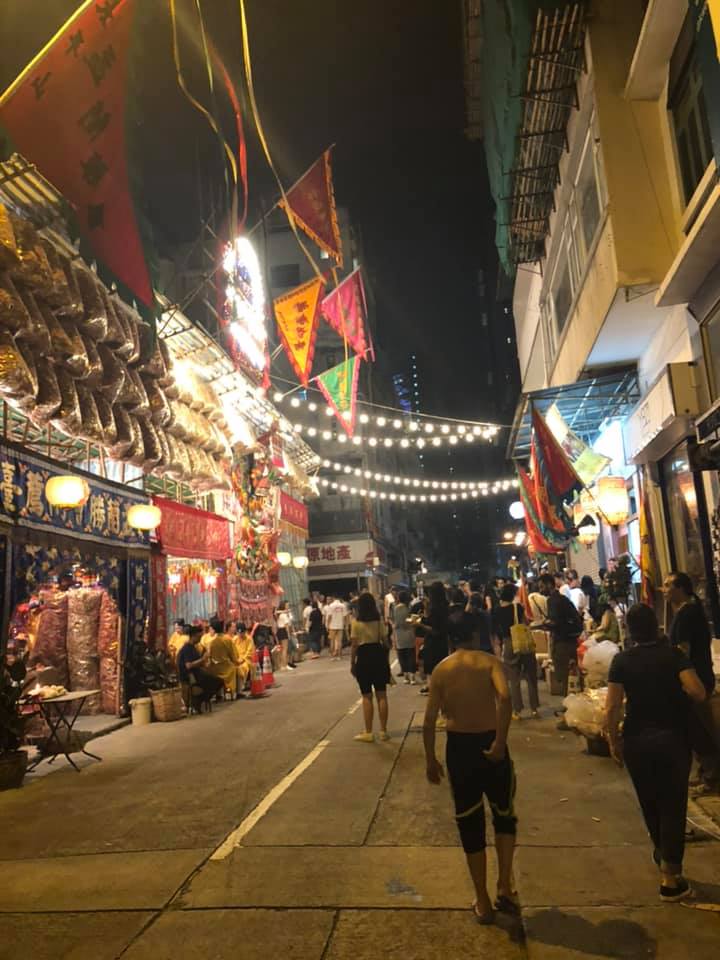
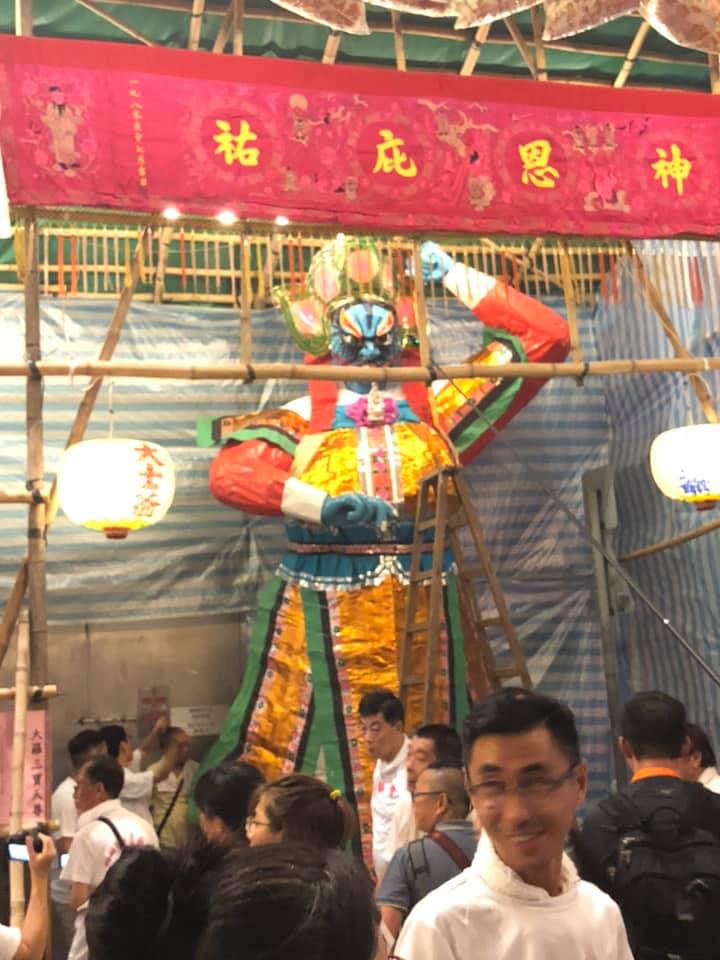
Bill, Maddie, and I were out for a walk on Saturday afternoon during a break in the heat when we came across preparations for the festival. Taoist priests, who had just presided at the mid-afternoon Ceremony of the Slicing up of Roast Pigs, were chanting and clapping as they walked around the block. A woman associated with the festival invited us to come back at 10:30 that night to watch the Beating Ceremony of the Ghost King.

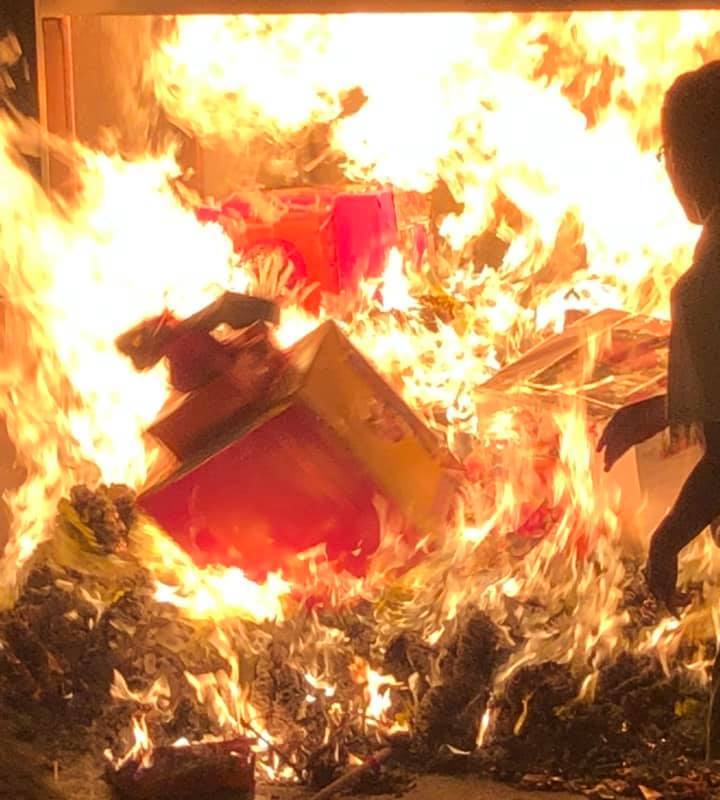
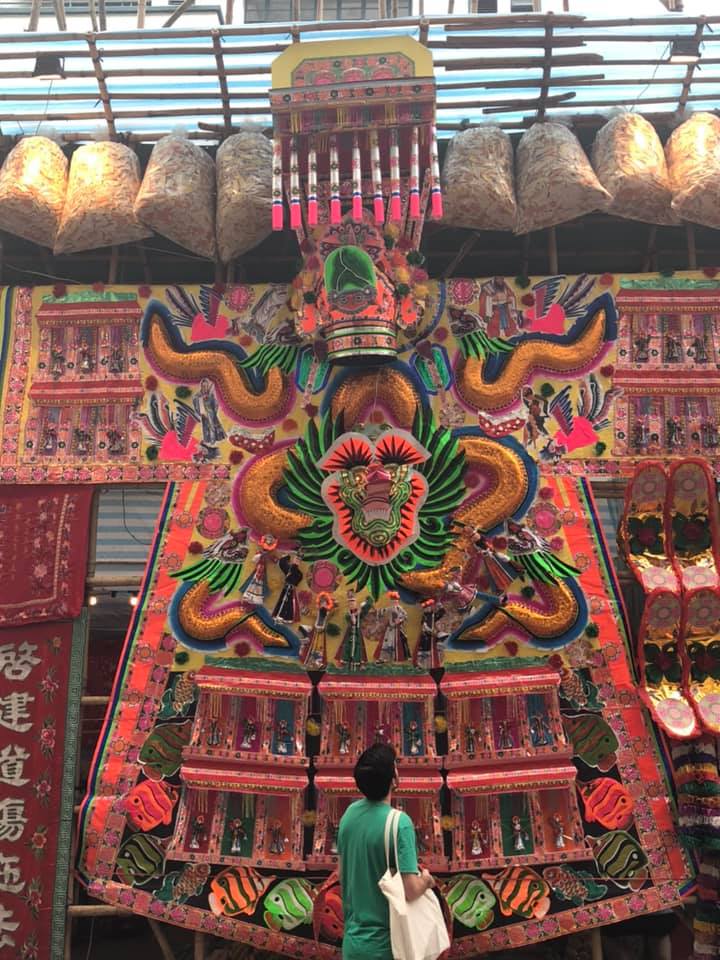
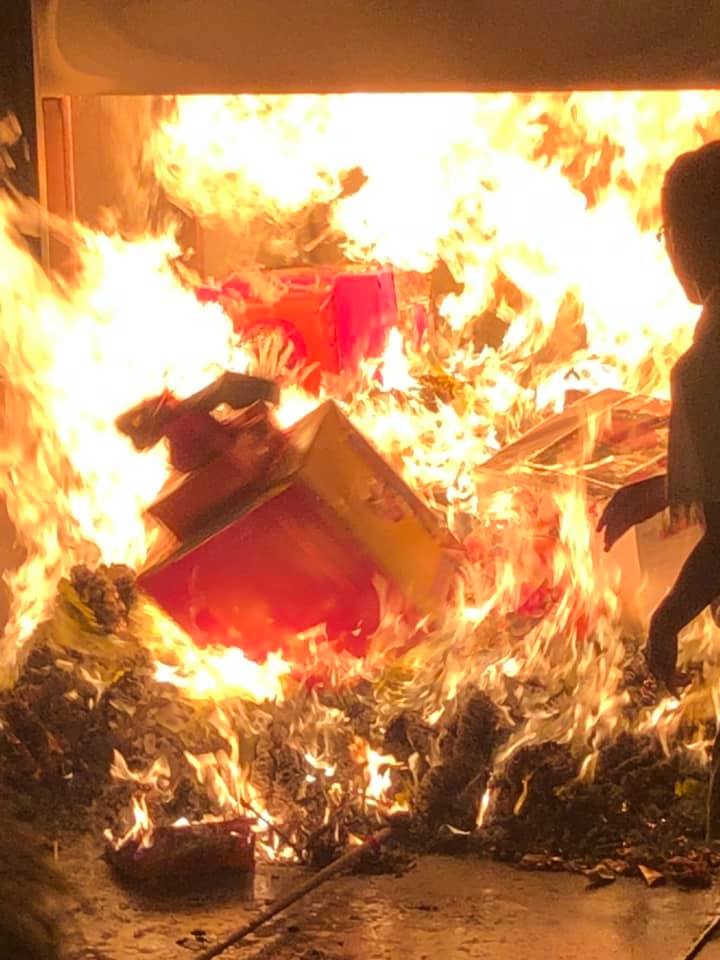
I’m glad we decided to come back, because even though 10:30 p.m. is pretty late these days, the ceremony was worth staying up. Exactly as promised, at 10:30 on the dot, a group of middle-aged men armed with large bamboo sticks surrounded the 15 feet tall paper mache King of the Ghosts, beat him to a pulp and then dragged him down the street to an incinerator, which burned him to nothing in 90 seconds.

As we were leaving, I noticed a donation box filled with $50s and $100s. Thinking that it might make sense to hedge our bets with the spirits, I made a small donation. I hope that as Hong Kong closes out a restless and seemingly endless summer, the bad luck of the hungry ghosts will fade and the city will be able to find its way back to a more auspicious fall.

Writing all the stories

There is so much that I want to write about. At any given time I have at least four or five long writing projects kicking around in my head and many more short projects. I get overwhelmed by the sheer number and then I have terrible writer’s block.  Because I want to tell all the stories. How can I choose where to start?

I want to write about standing underneath the watchful eye of a giant Buddha inside a cave on Marble Mountain, Danang that our tour guide casually mentioned was a Viet Cong field hospital during the “American War.”

I want to write about the Arrivals Hall at Hong Kong airport that following Monday, so filled with protestors wearing black and chanting anti-police slogans that after Maddie and I got separated from the boys, she looked up at me and asked, “Mom, are we in a war?”

I want to write silly things about how our Cantonese teacher corrected my pronunciation in class, telling me that instead of saying “restaurant menu” I said something more like “the chickens are running away.”  When we walked home after class on a city street that looks like Manhattan, we saw trash barrels on fire and Taoists feeding the flames with joss paper and fake money to appease the Hungry Ghosts.  My life in this city is a never-ending amusing anecdote about how I don’t belong…and I’m now mostly ok with that.

And on top of the personal, I really, really want to finish my in-progress-since-forever how-to book for millennial parents about writing their own Estate Plan without an attorney. Because it can be done and I think a lot of people need to know that. And I want to wrap up my drafting work with existing online clients because it can be awfully nice to get a check.

The kids are back in school. It’s time to get back to work.


Sunday Day of Mindfulness at Lotus Pond Temple

lotus pond image1

Almost every Sunday, the monastic brothers and sisters of Plum Village Hong Kong open their home to the public to share a day of mindfulness. Plum Village HK, also known as the Asian Institute of Applied Buddhism, continues in the tradition of Vietnamese Zen Buddhist teacher and peace icon, Brother Thich Nhat Hanh (Thay).  Laypersons from around the world travel here to spend the day walking, eating, learning, and meditating with the Sangha (the “beloved community” of practitioners.)  I was so happy and privileged to be able to spend the day among them yesterday.

I first learned of Thich Nhat Hanh in a Zen meditation class I took in college in the early 1990’s where we read his book, The Miracle of Mindfulness. For over 25 years, I have somehow managed to keep this little book on the transformative power of mindfulness practice with me as I’ve moved up and down the U.S. East Coast and now to Hong Kong.  To get to practice with men and women who have devoted their lives to following his teachings was a dream come true for me.

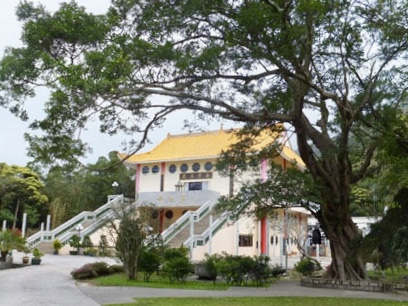
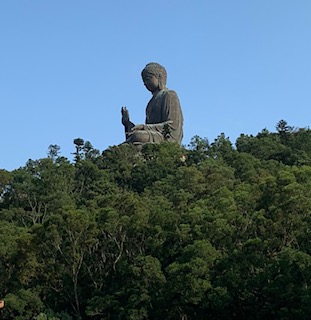
Plum Village HK is located at the Lotus Pond Temple on Lantau Island. It is remote. To make it to the 9:30 a.m. orientation, I had to leave our apartment in Central HK at 7:30.  I took the MTR train about an hour to the last stop on the Tung Chung line and then transferred to a local village bus that took me up the mountain to the Tian Tan Buddha (the Big Buddha). From there, I walked about another 15 minutes to the temple.

The walk should not have been that long, actually, but the temple is not on the main road and I got a little lost.  Fortunately, I ran into a fellow traveler who spoke Cantonese and she was able to ask a local farmer for directions. As we walked down an unpaved side road, the yellow tile of the temple roof became visible in the distance. We knew we were in the right place when we came upon a small group of young men and women in long brown robes laughing and talking quietly. They welcomed us and ushered us inside into the dining hall, where a nun was giving the orientation. We took off our shoes and joined them quietly.

Plum Village HK is a relatively small community of about 20 monastics, and many of the brothers and sisters were under 30 years old.  Unlike many monasteries, women and men are not separated in any way during daily activities and all responsibilities and opportunities are shared with absolute gender equity. This has been a cornerstone of Thay’s teaching since the 1960s.

Thich Nhat Hanh has founded Plum Village monasteries around the world, including Europe, the United States, and Asia. Though it is a small monastic community, Plum Village HK is the cornerstone of Thay’s vision of Applied Buddhism in Asia. In our Day of Mindfulness, we were to join in the daily life of the Sangha: working and sharing mindful fellowship in “joyful silence.”

Following a short sitting medication in the dining hall, we were invited to join with the Sangha on a mindfulness walk, which actually turned out to be a fairly challenging mountain hike.  Three dogs that have adopted the monastery joined our hike.  

After our walk, we met in the meditation hall for a question and answer session. Visitors were invited to ask questions of three monastics: two sisters and one brother. The questions were heartfelt, and the answers were thoughtful, practical, and kind.  The rest of the day followed a simple schedule: we ate lunch and cleaned up in silence, engaged in a “deep relaxation” (a nap), and finished with drinking tea meditation, singing, and group reflection.

At the end of the day, I decided to take the Ngong Ping 360 Cable Car back to Tung Chung, and I was able to get a photo of the Tian Tan Buddha rising through the trees. All in all, it was an amazing experience that I’m so grateful to have shared.

sitting buddha image1

Volunteering at ReDress

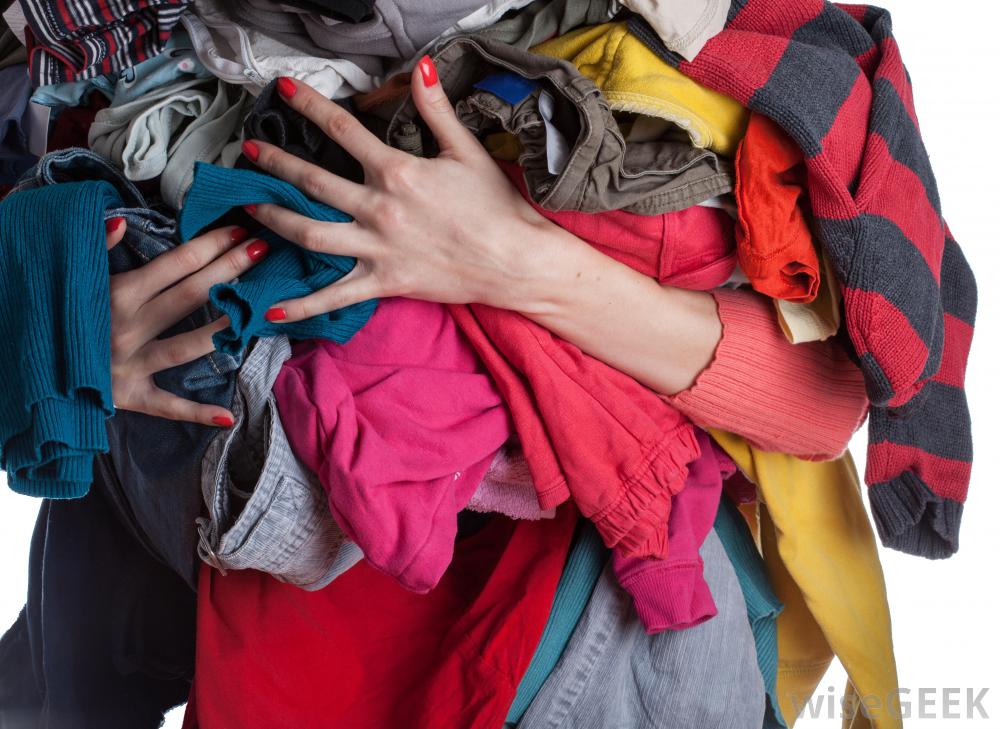
woman-holding-pile-of-clothesEvery single day in Hong Kong, approximately 373 tonnes (860,000 lbs.) of discarded textiles are dumped into landfills. Sadly, much of that textile waste is clothing that could have been reworn by someone else or recycled into new materials. More fundamentally, much of those textiles should probably never have been produced in the first place.
Enter ReDress.

ReDress is a Hong Kong-based NGO that partners with designers, manufacturers, and distributors to promote sustainability at all stages of the fashion life cycle.  Their biggest annual event is the ReDress Design Award, which is the world’s largest sustainable fashion design competition.  At the other end of the spectrum, ReDress also partners with fast fashion behemoth Zara to promote donation of used clothing for reuse or recycling.  At various times of the year, customers can bring their unwanted clothes to Zara for donation in exchange for discounts on new merchandise.

And while I think that these donation drives can be problematic in promoting the idea that it doesn’t matter what we buy if we are “recycling” it is at least a way of diverting clothing already purchased from the waste cycle.  This is where my kinda gross but also super awesome volunteering experience began…

The volunteer opportunity with ReDress was to help sort clothing donations at their receiving center in a Red Box storage facility in Chai Wan. (As an aside, I am learning that Hong Kong, like most cities, is a series of small distinctive neighborhoods. Some neighborhoods could literally be any city anywhere in the world, while others are decided “more Chinese.”  Chai Wan is definitely at the “more Chinese” end of the spectrum.) At the Red Box facility, I was greeted by the volunteer coordinator and ushered into a room where there was a huge pile of clothes on the floor and donation boxes lining the walls.

We were instructed to sort the clothes and shoes into a few categories. The best items were destined for the Hong Kong ReDress pop-up boutiques to be resold. Second-tier items were designated for another charity organization. The clothing that didn’t make the cut for charity (because it was dirty or stained etc.) was sorted to be sent to a recycling center. Anything else (including broken jewelry, belts, and “pleather” clothing too damaged for charity) was sorted for the landfill.

There was tremendous variation in the quality and condition of the items donated. I pulled out some cute dresses from bridge designers in good condition for the ReDress pop-up boutiques. But for every cute number that could be sent to the ReDress box, there were plenty of pairs of underpants and socks. I was glad we had been given gloves and face-masks.

After about four hours of work, we had sorted all the clothes and I was ready to go home. On the train, I thought about how growing up our family seasonally went through our wardrobes and donated items we didn’t want or couldn’t wear anymore.  As a little girl it was impressed on me that clothing is a valuable commodity and that it was important to try to give your unneeded clothes a “second life.”  But most of the donated clothes that we processed were graphic t-shirts and flimsy polyester tops that obviously had only been worn a few times, but were just not fashionable anymore. I was reminded of one of my favorite online articles on downsizing, Sorry, Nobody Wants Your Parents’ Stuff.

Except it was all of our stuff. We don’t even want our own stuff anymore.

At the risk of sounding like old-person-yelling-at-cloud, it seems to me that the clothing of my youth was categorically different from the clothing we have today. My grandmother had high quality day dresses and blouses that she wore for years. But even as I try to adhere to a capsule wardrobe and a minimalist aesthetic in general, I cannot even imagine being able to hold onto clothing like she did.

It’s super frustrating that modern fast fashion has become an inescapable part of our consumer culture, and quality clothing is really only available at out-of-reach price points. I’ve written before about how unrealistic it is to expect middle class consumers (who are ALWAYS feeling the squeeze) to pay $75 US for a t-shirt made from organic fibers and utilizing fair trade practices, when a facsimile is available at H&M for $15. But maybe by being a little more mindful about our clothing at all stages- from the selection, to the care and maintenance, to the eventual decision to remove it from our environment – we can reduce the staggering amount of waste created by the shirts on our back.


February Reflections

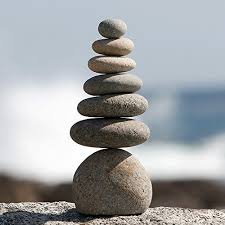
cairnA few weeks ago I dreamed I got to talk with a former mentor about our falling out.  I guess this has been lurking for years in my unconscious, along with low-lying shame about my lackluster legal career. In my dream I explained myself perfectly, my former mentor listened attentively, and she thanked me for sharing. Isn’t closure the best?
Except “closure” (like super thin eyebrows) is an outdated ’90s idea that only makes us look back in embarrassment. In the real world, I woke up at 3 a.m. to a minor existential crisis. To wit, what the actual hell am I doing in Hong Kong?  Then came the spiraling: I don’t have a job. I don’t have a car. I don’t even have Amazon Prime. Everyone else has something to do here. What is the point of me? What’s MY path??

But I need to Eff-ing calm down because moving to Hong Kong is not a thing that just “happened” to me. I may feel like a fish in a strange pond or an uprooted plant, but I am not actually those things.  Although I can’t deny the curious and strong deus ex machina that pervades my life, I have AGENCY.  I made a choice – a conscious choice — to leave the United States and come to Hong Kong for two years. I spent months preparing, and cleaning, and moving pets, and trying to wrap up projects with clients. I cleaned out the basement, for crying out loud.  I was EXCITED.

But the reality is that I just didn’t expect this to be so hard.

We have a saying in this family that “sometimes progress doesn’t look like progress.”

Some of the things we did this month that

  1. Chinese New Year vacation in Sai Kung
  2. Mrs. Norris arrives from Melrose
  3. Waiting on our new bedroom furniture
  4. Bill in Jakarta
  5. Liam hooks up the Playstation
  6. Maddie lands the role of Friar Tuck in the school play
  7. What is a “bad China”Day?

Ghost Person

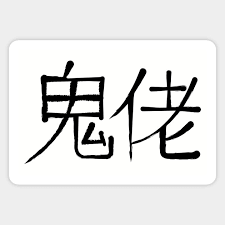
gweilo Gweilo is a Cantonese word used to describe white Westerners who live in China. I have read that it can translate to “ghost person,” for the obvious reason that we are pale, but also because, like ghosts, Gweilos appear suddenly and then vanish. In the spirit of reclaiming epithets, I think this expression makes sense. Like a ghost, I don’t belong in the space I occupy. I am often not noticed, and when I am, it is usually a surprise to the person who noticed me. I am a novelty, and, if I’m honest, kind of in the way.

Gweilo also translates as “foreign devil.” I like that less…but I get it too. The mid-levels, where we live, can be a mess of Americans, Australians, and Europeans after work — getting drunk, getting loud, getting awful. It’s easy to not be your best self here all the time and I think alcohol just makes things 100% worse. I’d rather be a ghost than a devil.

Our sea shipment has finally arrived from Massachusetts. As I write this, a crew is removing the furniture we have been renting for the past six weeks. Barring any last minute excitement at the Port of Hong Kong, our actual furniture (along with our books, photographs, and fancy hangers) has completed its long and arduous journey around the world and will be delivered to us tomorrow.

I know I’m prone to navel-gazing.  It’s really my least favorite personality quirk. But standing here (again) in a temporarily unfurnished apartment in Central Hong Kong just seems like a strange place to find a small-town girl from Pensacola, Florida. And even though I know being here is a tremendous gift, and even though I know it’s not about me anyway, and even though I know this is where all transformation happens, occupying liminal space is really fucking weird sometimes. So, today, I’m a ghost. An actual gweilo. And that’s just going to be ok.


Man Mo Temple

my man mo photo124-126 Hollywood Road, Sheung Wan, Hong Kong
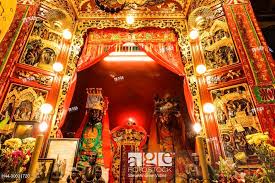
On Wednesday, January 23rd, I walked about a quarter-mile from our apartment to the Sheung Wan district. This area was the first part of the city to be settled by the British in the early 1840’s and is now a thriving shopping, dining, and antiques district. In the center of Sheung Wan, on bustling Hollywood Road, is the Man Mo Temple.

The Man Mo temple building was built in 1847. The building actually contains two temples, and a third function room which was traditionally used for community and government meetings. The Man Mo Temple proper is dedicated to the worship of two gods, Man Cheong and Mo Tai. Man Cheong is the God of Literature, while Mo Tai is the God of Warfare (or Martial Arts, depending on various traditions). The other temple is dedicated to the worship of all gods of all faiths, which seems pretty darn ecumenical to me. Like many things in this city, worship is a pragmatic act.

I have read that Man and Mo are gods who have been venerated by students seeking academic success. Historically, students would bring offerings to the Man Mo temple in Sheung Wan when they were preparing for the civil service exams that would help them land important and well-paying jobs with the Hong Kong government.  Praying and making supplications to Man and Mo was supposed to bring good fortune.

I know that students and their parents are encouraged to pray for good outcomes in school in anticipation of Chinese New Year, which starts this year on February 5th. With this in mind, I thought I might see a few grandparents milling around and praying at the temple.  I went to Man Mo at mid-day and I was totally unprepared for how busy the temples were and for how many young worshippers I saw. I was expecting a dusty antique and I experienced a vibrant community gathering that was both social and deeply personal.

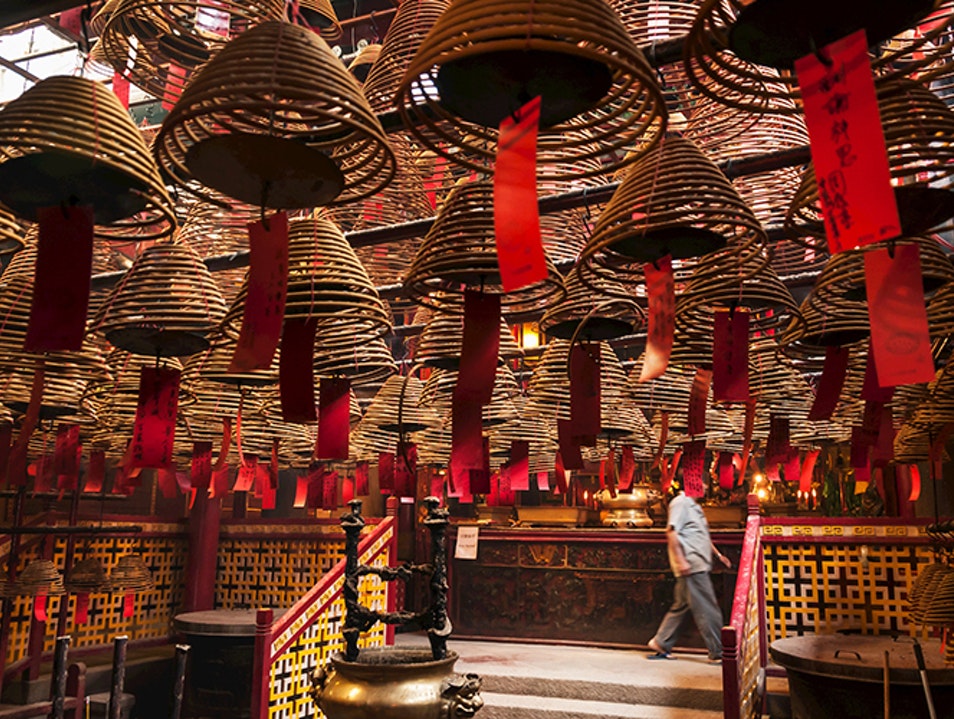
In the inner courtyard of the temple, there was a counter where worshippers could obtain joss papers  and incense sticks for burning.  The counter was surrounded by people but all was silent. The smell of incense was overpowering and only got more intense when I stepped through the main temple doors.  Thick coils of incense hung from the ceiling and there were sand-filled jars lining the room that contained burning incense sticks. man mo temple insense

I watched a man in his mid twenties approach a gong that was about five feet tall. He put some coins in a donation box next to the gong and then struck it with a leather hammer. He bowed with his hands in a prayer gesture and walked away. There were young women with fists full of incense sticks bowing and praying in front of two statues behind an ornately carved altar.

I tried to stay out of the way, all the while being very conspicuous of my foreignness and a little embarrassed about my ignorance. I thought about what it might be like to be in an Episcopal or Catholic Church, with no understanding of the Stations of the Cross or any of the depictions in the stained glass. Fortunately, no one even seemed to notice me and, unlike the woman at the temple in Cheung Chau, no one seemed to care that I was just standing to the side, taking it all in. (I feel like I should clarify that I didn’t take the two pictures posted here from inside the temple. I did take the header photo from outside the building.)

man and mo

I walked out just as a large mainland Chinese tour group arrived. You can always tell when it is a mainland tour group because the tour directors carry a flag and everyone herds around the guide. Unfortunately for me, the conversation is always in Chinese, so I can’t even eavesdrop.

Afterwards, I spent about an hour walking down a side street, where street vendors sold religious antiques, including gongs, mala beads, and Buddha statuary, in addition to CNY decorations and antique lanterns. I was hungry, so I got lunch at a Korean health food store on my way back home. I’ll definitely go back to Sheung Wan again.


Surprise! We moved to Hong Kong!

glenn-carstens-peters-190592-unsplash to do listJanuary has been an amazingly busy month for all of us and I’m anxious to write down the details before I forget. We rung in the New Year with a trip to Ocean Park Hong Kong, which is both an animal theme park and an amusement park located right on southern Hong Kong Island in Aberdeen. We just hopped on the MTR and rode the subway practically right to the front gates! Once we cleared the lines (which were pretty long) we rode thrill rides and checked out the protected harbor, where wild seals and sea lions swim freely and charm tourists. We even got to see a real-life Panda…eating bamboo just like in a documentary. It was awesome!

Here is a list of some of the highlights from January, which I hope to turn into their own short blog posts in time:

  1. The kids started school at Malvern College HK. This meant we had to make a few trips to the uniform supplier in Jordan, Kowloon District.
  2. We finally got to ride the AIA Hong Kong Observation Wheel . This almost 200 feet tall ferris wheel is located right on Victoria Harbor and the views of the city are incredible.
  3. We went to the movies and saw Spider Man Into the SpiderVerse. Popcorn at the movies in HK can be ordered “salty or sweet.” This truly is a brave new world.
  4. We needed to see more people, so we booked it to Mong Kok and browsed around the stalls. Lots of totally legit Rolox watches and LQL Doll merchandise along with an unbelievable flower market featuring an entire city block of four-foot tall bonsai trees.
  5. Last Saturday was kind of hazy with pollution, so we decided to get out of the city. We hopped a fast ferry to Cheung Chau island and bummed around.  We tried the famous frozen watermelon and mango mochi (NOT gluten-free). I bought a beautiful blue jade bracelet that coordinates with the one Bill bought me for my birthday. We combed the beach for sea glass and got too close to a temple for one local’s liking. We are definitely going back there because I am a little in love.
  6. Bill’s birthday is in January. We made him his favorite: yellow cake with chocolate icing (kinda basic but still great) and the kids judged it like Jacques Torres and Nicole Byer on Nailed It. We then went out to a Tapas restaurant in the Mid-levels where Liam ate calamari that was (1) not fried and (2) still had its tentacles.  A good time was had by all!
  7. I discovered that we are blocks away from the oldest temple in Hong Kong — the Man Mo Temple — and the most amazing antique district I’ve ever seen on Hollywood Road. UPDATED: Here’s the post.

Here are some other things that have been on our radar screen since the kids and I arrived on December 6th. Hopefully, I will work these into blog posts of their own in the near future.

  1. Flying a long-haul with two kids and an oxygen tank: lessons;
  2. The “serviced apartment” experience;
  3. Finding a Christmas tree on HK island;
  4. The Hong Kong Ballet interpretation of The Nutcracker;
  5. Getting a Hong Kong ID Card;
  6. Aberdeen Street and the Police Married Quarters (PMQ) project;
  7. Helper’s day off in Causeway Bay;
  8. Visiting the Peak via the Peak Tram
  9. Yau lok mm goi! The minibus experience; and
  10. Riding the central-mid-levels escalator system.

I have started running again and I am hopeful that with the kids in school I will find a yoga studio that resonates with me. I found one pretty close that offers aerial yoga…so that sounds like a contender. We are planning a trip to the beach community of Sai Kung Town early next month when the kids (and Bill) have a vacation for Chinese New Year and we are planning something big, big, big for April which is double-top secret for now. We are still awaiting our furniture and other home goods from the sea shipment, but we have an estimated port arrival date of January 26th, which is promising, and Mrs. Norris will be joining us on February 12th.