Bronze Star Citation, Lieutenant (junior grade) McGill

Gerald McGill, USCGA Class of 1965, was awarded a Bronze Star with Combat “V” for action against an enemy vessel during the Vietnam war.  The award was made by the President of the United States, Lyndon B. Johnson, and signed by Admiral John J. Hyland, United States Navy, Commander in Chief, U.S. Navy Pacific Fleet.  The Citation reads:

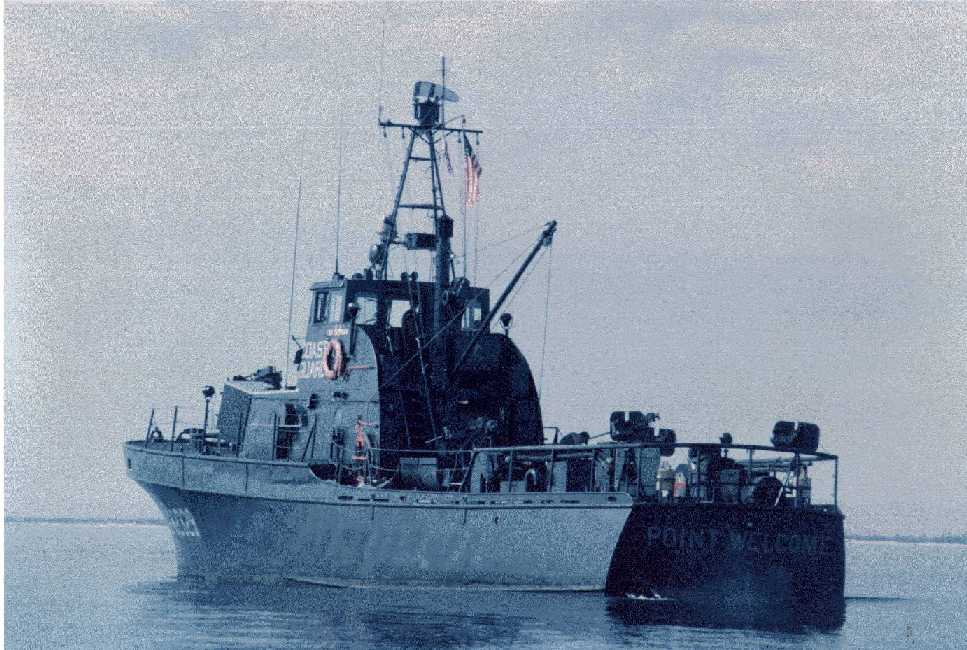
For heroic achievement in connection with operations against the enemy while serving with U.S. Naval Forces, Vietnam, and as Commanding Officer, USCGC POINT WELCOME, Lieutenant (junior grade) McGILL engaged in the interdiction of a Communist insurgent resupply ship on March 1, 1968.

Utilizing his vessel’s capabilities to the maximum extent, displaying superb seamanship and courageous and determined leadership under fire, he contributed very significantly in driving the enemy vessel ashore resulting in its subsequent self-destruction.  His magnificent use of his vessel’s weaponry resulted in numerous hits on the armed enemy ship, the suppression of return fire and interdiction of enemy attempts to offload the cargo which consisted of at least 650 small arms and large quantities of heavy caliber, automatic weapon and small arms ammunition.

The subsequent capture of this cargo deprived the Communist insurgents of sorely needed arms and ammunition.  Lieutenant (junior grade) McGILL’S courage under fire, superb ship handling and outstanding leadership were in keeping with the highest traditions of the United States Coast Guard and the United States Naval Service.

Lieutenant (junior grade) McGILL is entitled to wear the Combat “V”.

“Too Done” Eggs

By Gerald A. McGill

I was the Commanding Officer of the Point Welcome, an 82-foot Coast Guard Cutter from 22 October 1967 to 23 May 1968. For most of this time, I operated out of CG Division 12 in Danang Bay, approximately 40 miles south of the Demilitarized Zone (DMZ).  During my seven months as CO of the Point Welcome I was underway in the South China Sea 70% to 80% of the time.  This was typical of most of the other 82-foot cutters.

On 23 May 1968, I was relieved as CO of the Point Welcome and assigned to the Coast Guard Division 12 staff as the Readiness, Psychological, Operational and Intelligence Officer.  Once attached to the Division Staff, I lived aboard a U.S. Navy APL which was a large permanently moored ship tied up on the opposite side of the pier that the Coast Guard cutters and U.S. Navy PCFs (swift boats) moored while in port in Danang.

I was not too keen on shore duty, so I took every opportunity to do fill in duty aboard any of the 82s that had an opening.  For example, I would occasionally ride for a few days on an 82 that had been transferred to Danang from other Divisions to assist that unit with I Corps indoctrination and policies.

In addition to these short trips on WPBs, I was also sent for two weeks as the U.S. liaison officer to the South Vietnamese Coastal Group 16 about 30 miles south of Danang.

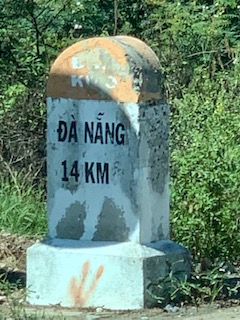
Danang Mile

Coastal Group 16 was at the mouth of a small river.  It was a contingent of South Vietnamese soldiers consisting of a few officers and a good many more soldiers and their families.  There were also civilians living there who were mostly fishermen.  The importance of the military was to prevent the Viet Cong from using the river to infiltrate weapons, ammunition, medical supplies and food up the river to their forces further inland.

On the morning of my arrival, I was told that there would be a feast in my honor that evening.  I was also introduced to my translator.  I spent the rest of the day looking around the compound.  Truth is I was looking for my exit strategy.

At the end of the workday, probably around 17:30, there was a gathering of 14 to 16 individuals sitting in a circle on the ground.  The village chief was seated at the head of the circle.  To his immediate right was a man, another civilian, who I assumed was the assistant chief.  I was shown to sit to his immediate right.   The rest of the circle was made up of a couple of military officers and enlisted men and several civilians who I assumed from their apparent age were the village elders.

When everyone was seated, a person appeared with a basket containing what appeared to be eggs.

I recalled hearing somewhere, probably from the Filipino cooks who served on Coast Guard high endurance cutters that they ate a Filipino dish called “balutes” which were fertilized and fermented duck eggs.  I was hoping that these eggs were not the Vietnamese version of “balutes”.

The first egg was presented to the village chief.  He held the egg in his left hand, smaller end up.  He took his knife and used the blade to break off the top of the egg, looked at the contents and then turned the eggshell up and in one motion drank the contents.  The next egg went to the assistant chief who performed the same ritual.  The next egg was presented to me.

I decapitated my egg with my knife and looked at the contents.  To my horror, I saw forming feathers and blood vessels.  Not wanting to offend anyone, particularly since my life could depend on them in the event of attack, I upended my egg.  In order to swallow the mass in my mouth, I had to chew several times.

Suddenly all eyes were on me.  I turned to my interpreter and said, “What did I do?”  He said only, “Too done, too done”.   Apparently, I had eaten an egg that they would have rejected.  I saw on at least 2 occasions that night when others would look at the contents and deciding that their eggs were “too done”, they would throw them out of the circle for the dogs to eat.  They would then be given a replacement egg.

Apparently by trying not to offend anyone, I came off as a barbarian.  No wonder some the village children ran away from me the next day.
Bad Shot Charlie Lived on Monkey Mountain

 by Gerald A. McGill

I flew into Saigon RVN on an American charter flight early in the morning of 17 October 1967.

I caught a ride with the U.S. Marines who were making their daily mail run to Cat Lo and Vung Tau about 30 miles south of Saigon at the mouth of the Mekong River.  I reported to the Commander, Coast Guard Division 13 as Prospective Commander Officer of the USCGC Point Welcome, an 82-foot steel hull Point-class cutter. On 22 October, 1967, I assumed command of the Pt Welcome.  I was 24 years old.

On 26 October, 1967 Pt Welcome was transferred to Division 12, Danang RVN about 400 miles to the north. On 28 October, 1967 I arrived in Danang.  It was a large harbor that reminded me of Pensacola Bay, in my hometown of Pensacola, Florida.   The main difference between the two is that the mountains that formed Danang harbor came right down to the edge of the water.  We could actually be right up to the water’s edge and have 100’ or more of water under us.

Our orders were to moor at the South Vietnamese Navy Junk Force Base.  There were 2 or 3 other 82’s that moored side by side to save dock space and we moored to the outboard 82.  Most of the other COs of 82s were from CGA classes 1963 and 1964.  I was one of the first of the class of 1965 to arrive.

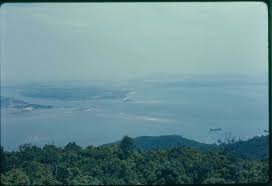
The Junk Force Base was at the foot of Monkey Mountain so called because of the monkeys that lived there.  Monkey Mountain was at the extreme southeast edge of Danang Harbor.  At the Base was housing for the Vietnamese Navy Officers, enlisted men and their families.  There was even an Officer’s Club and an Enlisted Club.

A sniper lived on Monkey Mountain.  No one ever knew whether he or she was Viet Cong or North Vietnam Army.  However, on occasions, apparently random, shots would be fired into the ARVN housing area sending the base into General Quarters and forcing the 82s to get underway out into the harbor.  Our 82s were underway about 75-80% of the time but the Pt Welcome was present at least twice when this happened.

Amazingly, the shots would hit in the middle of an empty street or the walls of the buildings but to my knowledge no person was ever hit.  Hence the saying, “’Bad Shot Charlie’ lived on Monkey Mountain.”

Upon reflection, many years later, I think “Bad Shot Charlie” was probably an excellent shot.  If he had ever hit anyone in the village, I believe the ARVN Marines would have gone up the mountain and hunted him down.  Even worse, the VC or NVA might have replaced him with someone who could and would shoot people.

____________________________________________________________________________

Definitions

RVN  Republic of Vietnam, i.e.  South Vietnam

ARVN  Army of the Republic of Vietnam,

NVA    North Vietnam Army

VC  Vietnamese in sympathy with North Vietnam

General Quarters  Everyone goes to battle stations and all are on alert.