
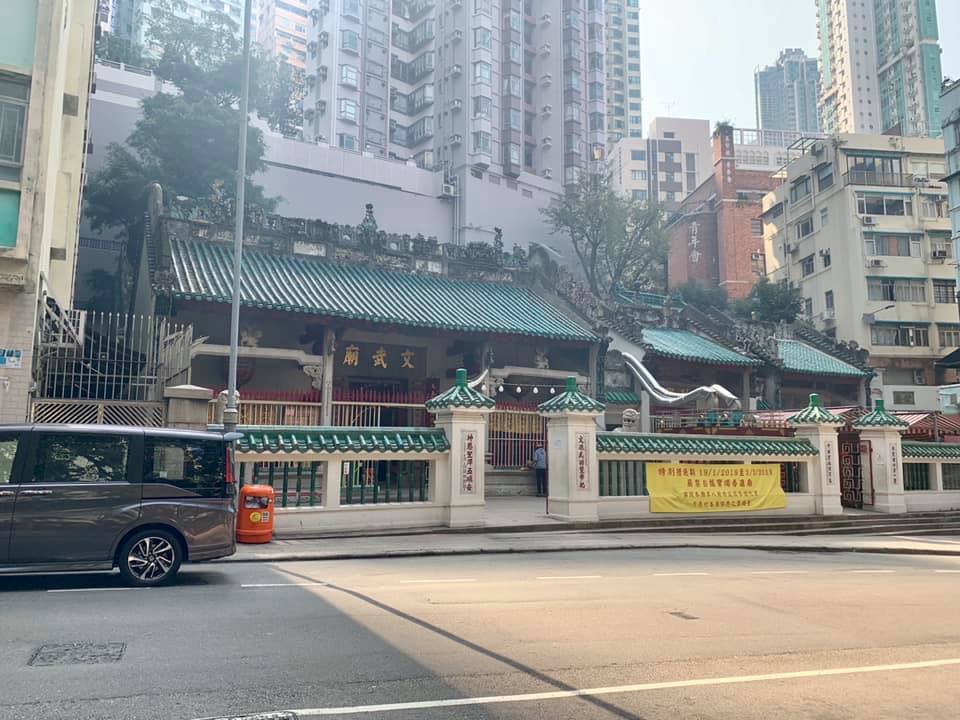
 124-126 Hollywood Road, Sheung Wan, Hong Kong
On Wednesday, January 23rd, I walked about a quarter-mile from our apartment to the Sheung Wan district. This area was the first part of the city to be settled by the British in the early 1840’s and is now a thriving shopping, dining, and antiques district. In the center of Sheung Wan, on bustling Hollywood Road, is the Man Mo Temple.
The Man Mo temple building was built in 1847. The building actually contains two temples, and a third function room which was traditionally used for community and government meetings. The Man Mo Temple proper is dedicated to the worship of two gods, Man Cheong and Mo Tai. Man Cheong is the God of Literature, while Mo Tai is the God of Warfare (or Martial Arts, depending on various traditions). The other temple is dedicated to the worship of all gods of all faiths, which seems pretty darn ecumenical to me. Like many things in this city, worship is a pragmatic act.
I have read that Man and Mo are gods who have been venerated by students seeking academic success. Historically, students would bring offerings to the Man Mo temple in Sheung Wan when they were preparing for the civil service exams that would help them land important and well-paying jobs with the Hong Kong government. Praying and making supplications to Man and Mo was supposed to bring good fortune.
I know that students and their parents are encouraged to pray for good outcomes in school in anticipation of Chinese New Year, which starts this year on February 5th. With this in mind, I thought I might see a few grandparents milling around and praying at the temple. I went to Man Mo at mid-day and I was totally unprepared for how busy the temples were and for how many young worshippers I saw. I was expecting a dusty antique and I experienced a vibrant community gathering that was both social and deeply personal.
In the inner courtyard of the temple, there was a counter where worshippers could obtain joss papers and incense sticks for burning. The counter was surrounded by people but all was silent. The smell of incense was overpowering and only got more intense when I stepped through the main temple doors. Thick coils of incense hung from the ceiling and there were sand-filled jars lining the room that contained burning incense sticks. 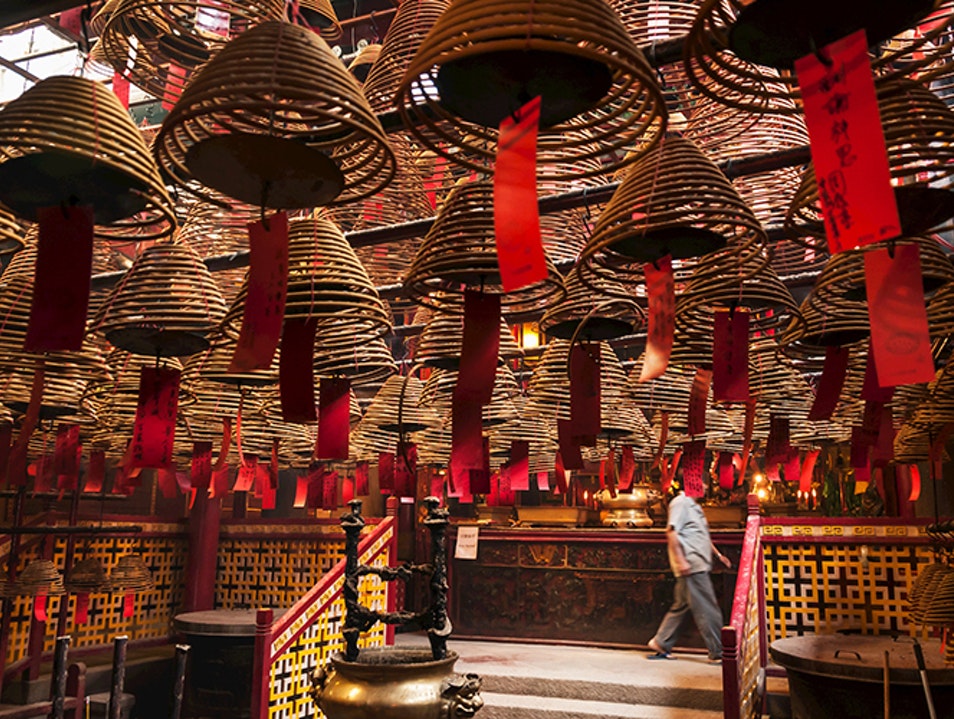
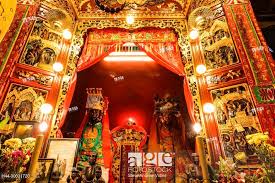
I watched a man in his mid twenties approach a gong that was about five feet tall. He put some coins in a donation box next to the gong and then struck it with a leather hammer. He bowed with his hands in a prayer gesture and walked away. There were young women with fists full of incense sticks bowing and praying in front of two statues behind an ornately carved altar.
I tried to stay out of the way, all the while being very conspicuous of my foreignness and a little embarrassed about my ignorance. I thought about what it might be like to be in an Episcopal or Catholic Church, with no understanding of the Stations of the Cross or any of the depictions in the stained glass. Fortunately, no one even seemed to notice me and, unlike the woman at the temple in Cheung Chau, no one seemed to care that I was just standing to the side, taking it all in. (I feel like I should clarify that I didn’t take the two pictures posted here from inside the temple. I did take the header photo from outside the building.)
I walked out just as a large mainland Chinese tour group arrived. You can always tell when it is a mainland tour group because the tour directors carry a flag and everyone herds around the guide. Unfortunately for me, the conversation is always in Chinese, so I can’t even eavesdrop.
Afterwards, I spent about an hour walking down a side street, where street vendors sold religious antiques, including gongs, mala beads, and Buddha statuary, in addition to CNY decorations and antique lanterns. I was hungry, so I got lunch at a Korean health food store on my way back home. I’ll definitely go back to Sheung Wan again.
 Nobles Family Blog