1940-1945 — Leading up to and during World War II, Japan occupies Indochina, allowing the Vichy French government to retain nominal control over much of its former colonial territory, including Laos, Cambodia, and Vietnam.
15 August 1945 — Japan unconditionally surrenders to Allied Powers, creating a massive power vacuum across the Asia-Pacific region.
02 September 1945 — Japan signs the Japanese Instrument of Surrender, officially ending World War II. That same day, in the city of Hanoi, Ho Chí Minh declares Vietnamese independence, founding the communist Democratic Republic of Vietnam (DRV).
19 December1946 — The First Indochina War begins between the communist forces of the DRV and the French colonial interests seeking to retake their former colonies.
01 May 1950 — U.S. President Harry Truman approves $10 million USD in military assistance to support anti-communist efforts in Indochina.
26 April 1954 — The Geneva Conference is convened to resolve outstanding issues in Korea and ongoing hostilities in Indochina.
7 May 1954 — The French are decisively defeated by the DRV at the Battle of Dien Bien Phu.
20 July 1954 — Parties to the Geneva Conference agree to divide the country of Vietnam into two “zones” at the 17th Parallel: the northern Democratic Republic of Vietnam, and the southern State of Vietnam, led by Emperor Bao Dai. This division was intended to be temporary pending reunification elections that were to occur in 1956.
1954 — Emperor Bao Dai asks Ngo Dinh Diem to serve as Prime Minister of the State of Vietnam.
26 October 1955 — Prime Minister Diem deposes Emperor Bao Dai and declares himself President of the newly formed Republic of Vietnam (RVN).
01 November 1955 — U.S. President Dwight D. Eisenhower deploys American servicemen as part of the Vietnam Military Assistance Advisory Group (MAAG) to train the Army of the Republic of Vietnam, This action is considered the official beginning of American involvement in the Vietnam war. During this time, the DRV engages in violent “anti-landlord” campaigns in the north, deposing landholders of property in a forced redistribution of wealth.
April 1956 — Last French troops leave Vietnam. The national unification elections planned for at the 1954 Geneva Conference fail to occur.
08 June 1956 — Air Force T-Sgt. Richard B. Fitzgibbon Jr. becomes the first American war casualty when he is murdered by a fellow U.S. serviceman following an argument.
December 1958 — The DRV invades Laos. Laos would become an important part of the DRV’s logistics system, known to some as the Ho Chi Minh Trail, supplying goods, arms, and troops between the DRV and sympathetic forces in the Republic of Vietnam.
20 December 1960 — The National Liberation Front of South Vietnam (Viet Cong) is formed by the DRV as an insurgency movement inside the Republic of Vietnam.
May 1961 — U.S. President John F. Kennedy, Jr. authorizes 500 Special Forces troops and military advisers to assist the Republic of Vietnam.
November 1961 — The United States Joint Chiefs of Staff directs Commander-in-Chief, Pacific (CINCPAC) to look into the RVN Navy’s poor performance against DRV infiltration.
11 June 1963 — Buddhist monk Thich Quang Duc self-immolates in Saigon to protest RVN President Diem’s persecution of Buddhists.
02 September 1963 — President Kennedy criticizes President Diệm in an interview with Walter Cronkite, citing his repression of Buddhists and claims that Diệm is out of touch with his countrymen.
02 November 1963 — President Diem is assassinated in a military coup. Gen. Duong Van Minh, leading the Revolutionary Military Committee of the dissident generals who had conducted the coup, takes over leadership of RVN. A period of instability culminating in a series of military coups would continue until the U.S.-ordered elections of 1967.
22 November 1963 — President Kennedy is assassinated in Dallas, TX. By this time, about 16,000 military advisors have been sent to Vietnam.
27 July 1964 — American President Lyndon B. Johnson sends 5,000 additional military advisors to Vietnam.
02 August 1964 — Gulf of Tonkin Incident leads Congress to grant President Johnson authority to assist any Southeast Asian country whose government was “jeopardized by communist aggression”. The resolution serves as Johnson’s legal justification to begin open warfare against the DRV.
16 February 1965 — A U.S. Army helicopter pilot flying over Vung Ro Bay near Qui Nhon notices an “island” moving slowly from one side of the bay to the other. Upon closer observation, he discovers the “island” was a carefully camouflaged ship. Air strikes were called in, destroying the ship. Intelligence sources determine the ship was DRV and engaged in supplying enemy forces.
8 March 1965 — The first U.S. combat troops arrive in Vietnam as 3500 Marines land at My Khe Beach to defend the American air base at Danang. They join 23,000 American military advisers already in Vietnam. Over the course of this year, troop levels make a significant rise to approximately 185,000.
March 1965 — The Coastal Surveillance Force is established, creating a single command to coordinate sea, air and land units of the U.S. Navy and South Vietnamese naval units.
29 April 1965 — President Lyndon B. Johnson commits to the formation of Coast Guard Squadron One (RON ONE) for service in Vietnam.
June 1965 — Gerry McGill graduates from the United States Coast Guard Academy in New London, CT.
16 July 1965 — Division 12 of RON ONE departs from Subic Bay, Philippines for Danang. It arrives on 20 July and begins security and surveillance patrols the following day. Forty-seven officers and 198 enlisted personnel were assigned to RON ONE.
19 September 1965 — First Coast Guard engagements in Vietnam War occur, near the Cambodian Border in the Gulf of Thailand. In two separate incidents on the same day, the USCGC Point Marone (WPB 82321) and the USCGC Point Glover (WPB 82307) come under fire by Viet Cong forces and return fire, resulting in the destruction of the Viet Cong vessels. No Coast Guardsmen are injured in either encounter.
1966 — President Johnson again expands the number of troops being sent into Vietnam to 385,000.
1967 — American troop levels continue to rise, with 485,600 military personnel in-country.
3 September 1967 — Military General Nguyễn Văn Thiệu is elected President of the Republic of Vietnam. He would remain in office until the fall of Saigon.
17 October 1967 — Lt. (jg) McGill arrives in Saigon, RVN.
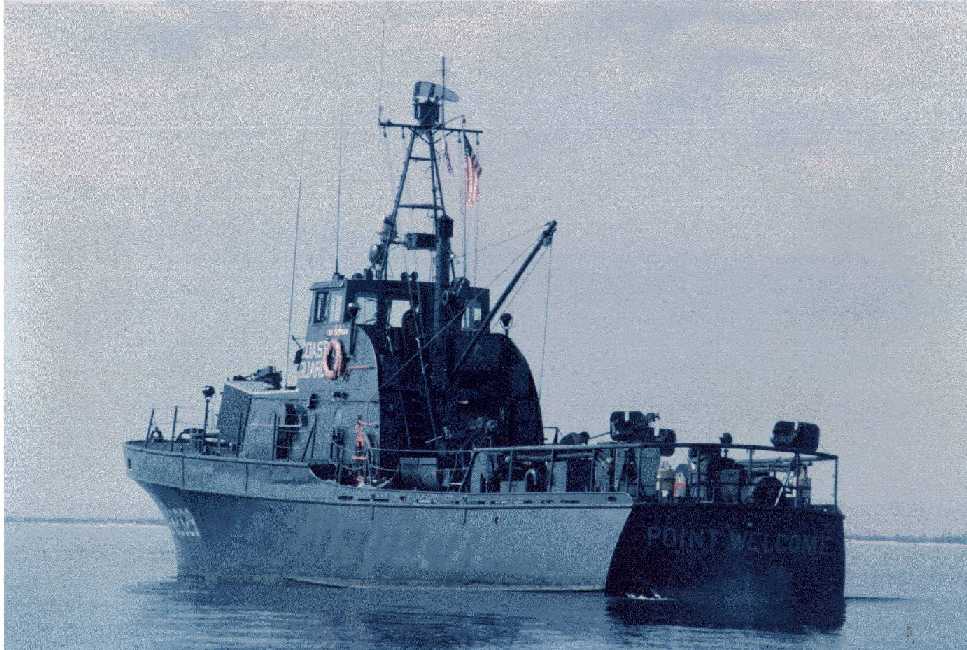
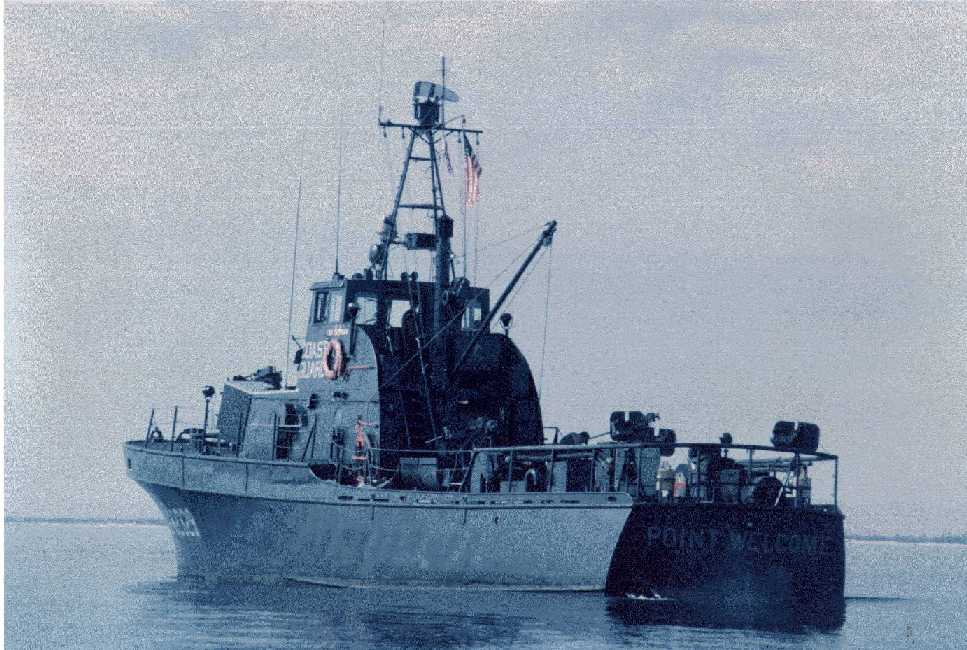
22 October 1967 — Lt. (jg) McGill assumes command of Pt. Welcome (WPB 82329) at Cat Lo, Coast Guard Division 13.
26 October 1967 — Pt. Welcome reassigned from Division 13 to Coast Guard Division 12, Danang, RVN.
30 January 1968 — Tet Offensive Begins.
01 March 1968 — Operation Market Time captures/destroys 3 enemy vessels. A fourth vessel aborted the mission and returned to international waters.
16 March 1968 — Senator Robert F. Kennedy announces his intent to primary sitting President Johnson. Polls indicate Kennedy would be the more popular candidate.
31 March 1968 President Johnson addresses the nation reporting his decision not to seek reelection and announcing steps to limit the war in Vietnam.
23 May 1968 — Lt. (jg) McGill is reassigned to CG Division 12 as the Readiness, Psychological, Operational and Intelligence Officer.
1968 — American troops reach peak of approximately 536,000.
10 October 1968 — Lt. (jg) McGill flies out of Danang, Vietnam, bound for a new assignment in the United States.
29 April 1970 — Pt. Welcome is decommissioned and transferred to Republic of Vietnam Navy.
27 January 27 1973 — President Nixon signs the Paris Peace Accords on behalf of the United States, officially ending direct U.S. involvement in Vietnam. In the Accords, also signed by representatives of the DRV, RVN, and Viet Cong, the parties agree to implement a cease-fire and work cooperatively to establish precise delineations of government zones of control. The ceasefire does not last beyond one month.
29 April 1975 — American Radio Service announces that the temperature in Saigon is “105 degrees and rising” and starts playing the song “White Christmas,” in a signal to American Embassy personnel to go to their nearest assembly point for final evacuation from Saigon as the DRV take the city. The war is over.
The
Point Welcome had just completed a 5 day patrol in area 3B just off the coast
near Qui Nhon. Rather than make the
longer trip back to Danang, we moored at the U.S.N. Swift boat base located on
the north shore of the harbor. It was
January 30, 1968 at approximately 1600.
As usual we took on fuel and fresh water.
The harbor at Qui Nhon was a much smaller harbor than Danang. On the south side of the harbor was the city of Qui Nhon. On the north shore approximately one mile away was the U.S.N. Swift boat base.
Rumor had it that the city was an in-country R&R (Rest and Recreation) center for both Viet Cong and South Vietnamese Forces. The South Vietnamese Forces used it during the day and the VC used it at night. I don’t know if that was true or not but neither I nor my crew visited the city.
The Swift boat base had an Officer’s Club and an Enlisted men’s Club each complete with a cash bar, pool tables and tables and chairs, many of which were used for playing poker or other card games.
There was a mountain behind the base. The other side of the mountain was considered VC and NVA territory.
The U.S. Army had a couple of tanks on the city side. On occasion the tanks would fire Harassment and Interdiction (H&I) rounds over the Swift boat base into the mountain top on our side. We always worried about a “short round” when they were firing over our heads but we were glad they were there that night.
At about 18:30 after supper, I walked about 100 yards from the pier to the Quonset hut that served as the Officer’s Club and also for the berthing area for Swift boat officers who were not on patrol.
I was in the Quonset hut playing poker with several Swift boat officers. We were in the back part of the Quonset hut about 150 feet from the front door. About 19:30 we heard the sounds of small arms and automatic weapons fire. Then the tanks began firing. Suddenly the front door was kicked open and a person dressed in all black who appeared to be carrying a weapon burst in. Thinking it was a bad joke, one of the Navy officers said words to the effect: “C’mon man, that’s not funny.” And it wasn’t as the man fired two or three shots. The Swift boat officers ran for their weapons.
I did not have my side arm (a .45 caliber pistol) with me but even if I had, I still felt that I needed to get back to my boat. I recall that I was winning at poker for a change but when the firing started, we left everything on the cable spool we were using for a table.
Apparently, the VC came over the mountain into the base. I went out the back door of the Quonset hut and dropped to the beach. Fortunately the beach was about six feet below the path I took to the Officer’s Club, having been eroded by the waves.
I had played soccer and baseball at the Coast Guard Academy, but I was not noted for my speed. But I am certain this was the fastest 100 yard dash I ever ran.
As I got closer to the boat, I could hear some of my crew yelling “Run, Skipper, Run”. Apparently they could see me with the night vision glasses. When they pulled me aboard, I was proud of my crew. The vessel was blacked out, both engines were running, all mooring lines had been cast off and all the machine guns were manned. Someone said, “All hands are accounted for.”
We turned the boat and headed out into the harbor. All lines of communication were so overloaded no one could communicate with anyone.
I made the decision to return to our previous Market Time area in 3B.
We didn’t know at the time that this was the start of the Tet Offensive throughout South Vietnam.
Photo: USCG photo. Division 11 of Coast Guard Squadron One departs Subic Bay Naval Base for Vietnam, 17 July 1965. USCGC Point Marone (WPB-82331) is in foreground.
Today is the 48th anniversary of the initiation of Operation Market Time, an experience that would mark a generation of Coast Guard Cuttermen, and provides a template for the sort of operations the Coast Guard might be involved in the future. There is a good history of the Coast Guard’s role in the operation here.
In November 1961, the United States Joint Chiefs of Staff had directed Commander-in-Chief, Pacific (CINCPAC) to look into the South Vietnamese Navy’s poor performance against enemy infiltration into South Vietnam. CINCPAC, heading up the review team, wanted a Coast Guard perspective.
Commander John B. Speaker, Jr. from Coast Guard Headquarters in Washington D.C. landed in Saigon on 10 November 1961. His blunt report to the U.S. Coast Guard Commandant was very unfavorable of the South Vietnamese Navy. He found ship board maintenance extremely poor, the food bad, and ship board drills and training rarely carried out. At any time half the South Vietnamese Sea Force could not get underway because of machinery breakdowns.
Prior to returning to Washington D. C., Cdr. Speaker stopped in Honolulu to tell CINCPAC what the Coast Guard could do to help. One of Speaker’s comments was that if the United States joined in the fighting, Coast Guard cutters were available and were best used in the hands of Coast Guardsmen.
Since the start of fighting in 1960, the U.S. Army in Vietnam contended that most of the supplies reaching the Viet Cong and the North Vietnamese Army in South Vietnam were coming in by sea. The U.S. Navy disagreed on the basis of insufficient evidence. That position changed in February, 1965.
In February, 1965 a U. S. Army helicopter pilot flying a HU-1B Iroquois over Vung Ro Bay near Qui Nhon noticed an “island” moving slowly from one side of the bay to the other. Upon closer observation, he saw the “island” was a carefully camouflaged ship. Air strikes were called in and the vessel was sunk. Intelligence sources determined that ship was North Vietnamese and engaged in supplying enemy forces.
Now the U.S. Navy recognized the need for an effective security and surveillance system. The Navy also recognized that setting up such a system would be a great challenge. South Vietnam has 1200 miles of coastline to patrol and an estimate of 60,000 trawlers, junks and sampans to control.
In March, 1965, the Coastal Surveillance Force was established and began Operation Market Time named after the native boats using the waterways for fishing and marketing. This task force provided for a single command to coordinate sea, air and land units of the U.S. Navy and South Vietnamese naval units.
Very soon the U.S. Navy recognized the need for Coast Guard units to support this mission. On April 29, 1965, President Lyndon Johnson committed to the formation of Coast Guard Squadron One (RON ONE).
Initially 47 officers and 198 enlisted personnel were assigned to RON ONE. On 16 July, Division 12 of RON ONE departed from Subic Bay, Philippines for Da Nang, Republic of Vietnam. It arrived on 20 July 1965 and began its security and surveillance patrols on 21 July 1965.
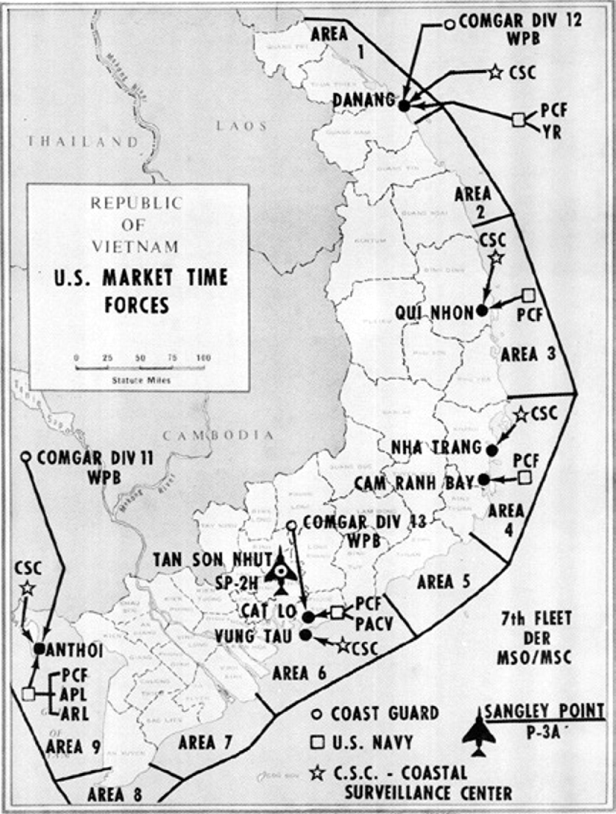
Division 12 consisted of eight 82’ patrol cutters and support staff which had been flown in earlier. The Division 12 patrol areas were from the 17th parallel, which was the Demilitarized Zone (DMZ) separating North from South Vietnam to Qui Nhon approximately 400 miles to the South.
Division 11 patrol areas were from the border of Laos and Cambodia and North Vietnam in the Gulf of Thailand south approximately 400 miles to the mouth of the Mekong River Delta south of Saigon. Division 11 had nine 82’ patrol boats assigned to it.
The Coast Guard’s first combat engagements came on 19 September 1965. At 22:30, near the Cambodian Border in the Gulf of Thailand, the USCGC Point Marone (WPB 82321) closed on a 35 foot junk for boarding. The occupants of the junk responded with small arms fire. When the encounter was over, nine Viet Cong were dead and one critically wounded. There were no Coast Guard casualties.
At a little after midnight, in the same area, the USCGC Point Glover (WPB 82307) ordered a 24 foot motorized junk to stop. The junk reacted by trying to ram the cutter. The cutter dodged the junk and its crew fired into the junk’s engine. When the junk went dead in the water, the five suspected Viet Cong aboard jumped overboard. One was fished from the water by another cutter and taken prisoner. The others either escaped or drowned.
For the first time, since World War II, the Coast Guard was at war again.
At
the time of the first combat encounters in Vietnam, Coast Guard cutters had
white hulls. This had always been true
of Coast Guard vessels, large and small.
The main reason for having white hulls is that the primary mission of
the Coast Guard is search and rescue of vessels in distress. In these missions, visibility is desirable.
Soon after the initial combat engagements, however, an order came from Market Time Headquarters that all the WPBs* were to be painted gray. In retrospect the order made sense but Guardsmen take great pride in their white hulled vessels and at the time many were displeased. Some felt that if they had wanted to go to sea on gray ships, they would have joined the Navy. But there was no choice given.
Ever resourceful, Coast Guardsmen soon discovered that by adding a couple of tablespoons of black paint to each gallon of Navy gray paint they created a black-gray shade giving the cutter a more menacing appearance and a lot less visibility. This ended most of the grumbling.
In the United States, the 82s had white hulls and their hull numbers were painted in black for contrast. All hull numbers consisted of five numbers with the first two numbers 82. The Point Welcome was 82329. When the Vietnam cutters were painted “Coast Guard” gray, the numbers were painted the lighter “Navy” gray for contrast.
*WPB – General term for all Coast Guard patrol boats
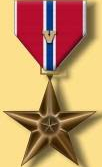
Gerald McGill, USCGA Class of 1965, was awarded a Bronze Star with Combat “V” for action against an enemy vessel during the Vietnam war. The award was made by the President of the United States, Lyndon B. Johnson, and signed by Admiral John J. Hyland, United States Navy, Commander in Chief, U.S. Navy Pacific Fleet. The Citation reads:
For heroic achievement in connection with operations against the enemy while serving with U.S. Naval Forces, Vietnam, and as Commanding Officer, USCGC POINT WELCOME, Lieutenant (junior grade) McGILL engaged in the interdiction of a Communist insurgent resupply ship on March 1, 1968.
Utilizing his vessel’s capabilities to the maximum extent, displaying superb seamanship and courageous and determined leadership under fire, he contributed very significantly in driving the enemy vessel ashore resulting in its subsequent self-destruction. His magnificent use of his vessel’s weaponry resulted in numerous hits on the armed enemy ship, the suppression of return fire and interdiction of enemy attempts to offload the cargo which consisted of at least 650 small arms and large quantities of heavy caliber, automatic weapon and small arms ammunition.
The subsequent capture of this cargo deprived the Communist insurgents of sorely needed arms and ammunition. Lieutenant (junior grade) McGILL’S courage under fire, superb ship handling and outstanding leadership were in keeping with the highest traditions of the United States Coast Guard and the United States Naval Service.
Lieutenant (junior grade) McGILL is entitled to wear the Combat “V”.
Commander
Coast Guard Division 12
Box 88 NAVSUPPACT
FPO San Francisco 96695
FOR IMMEDIATE RELEASE
Release Number 23-68
March 18, 1968
REMAINS OF ENEMY TRAWLER AND CARGO RECOVERED
DANANG March 18 – The U.S. Coast Guard Cutter Point Welcome crew received an unexpected souvenir of the enemy trawler forced ashore 85 miles south of here March 1.
Closely pursuing the arms and munitions laden vessel to shore, the cutter was showered by bits of ship and cargo when the enemy craft was destroyed by her own crew to avoid capture.
The Point Welcome, a scant 500 yards away, discovered a bent enemy carbine bayonet under her small boat and a single board from one of the trawler’s hatches floating nearby following the blast.
Salvage crews and divers later recovered some 600 enemy carbines, 41 submachine guns, a heavy machine gun and an assortment of hand grenades, mortar rounds, detonators and ammunition scattered over a two-square-mile area.
The Point Welcome is one of 26 Coast Guard 82-foot patrol boats operating off the coast of South Vietnam in support of Operation Market Time. The cutters conduct frequent patrols in search of the enemy attempting to infiltrate men and supplies into South Vietnam by sea.
The Point Welcome is commanded by Lieutenant (jg) Gerald A. McGILL , USCG, from Pensacola, Florida.
I was the Commanding Officer of the Point Welcome, an 82-foot Coast Guard Cutter from 22 October 1967 to 23 May 1968. For most of this time, I operated out of CG Division 12 in Danang Bay, approximately 40 miles south of the Demilitarized Zone (DMZ). During my seven months as CO of the Point Welcome I was underway in the South China Sea 70% to 80% of the time. This was typical of most of the other 82-foot cutters.
On 23 May 1968, I was relieved as CO of the Point Welcome and assigned to the Coast Guard Division 12 staff as the Readiness, Psychological, Operational and Intelligence Officer. Once attached to the Division Staff, I lived aboard a U.S. Navy APL which was a large permanently moored ship tied up on the opposite side of the pier that the Coast Guard cutters and U.S. Navy PCFs (swift boats) moored while in port in Danang.
I was not too keen on shore duty, so I took every opportunity to do fill in duty aboard any of the 82s that had an opening. For example, I would occasionally ride for a few days on an 82 that had been transferred to Danang from other Divisions to assist that unit with I Corps indoctrination and policies.
In addition to these short trips on WPBs, I was also sent for two weeks as the U.S. liaison officer to the South Vietnamese Coastal Group 16 about 30 miles south of Danang.
Coastal Group 16 was at the mouth of a small river. It was a contingent of South Vietnamese soldiers consisting of a few officers and a good many more soldiers and their families. There were also civilians living there who were mostly fishermen. The importance of the military was to prevent the Viet Cong from using the river to infiltrate weapons, ammunition, medical supplies and food up the river to their forces further inland.
On the morning of my arrival, I was told that there would be a feast in my honor that evening. I was also introduced to my translator. I spent the rest of the day looking around the compound. Truth is I was looking for my exit strategy.
At the end of the workday, probably around 17:30, there was a gathering of 14 to 16 individuals sitting in a circle on the ground. The village chief was seated at the head of the circle. To his immediate right was a man, another civilian, who I assumed was the assistant chief. I was shown to sit to his immediate right. The rest of the circle was made up of a couple of military officers and enlisted men and several civilians who I assumed from their apparent age were the village elders.
When everyone was seated, a person appeared with a basket containing what appeared to be eggs.
I recalled hearing somewhere, probably from the Filipino cooks who served on Coast Guard high endurance cutters that they ate a Filipino dish called “balutes” which were fertilized and fermented duck eggs. I was hoping that these eggs were not the Vietnamese version of “balutes”.
The first egg was presented to the village chief. He held the egg in his left hand, smaller end up. He took his knife and used the blade to break off the top of the egg, looked at the contents and then turned the eggshell up and in one motion drank the contents. The next egg went to the assistant chief who performed the same ritual. The next egg was presented to me.
I decapitated my egg with my knife and looked at the contents. To my horror, I saw forming feathers and blood vessels. Not wanting to offend anyone, particularly since my life could depend on them in the event of attack, I upended my egg. In order to swallow the mass in my mouth, I had to chew several times.
Suddenly all eyes were on me. I turned to my interpreter and said, “What did I do?” He said only, “Too done, too done”. Apparently, I had eaten an egg that they would have rejected. I saw on at least 2 occasions that night when others would look at the contents and deciding that their eggs were “too done”, they would throw them out of the circle for the dogs to eat. They would then be given a replacement egg.
Apparently by trying not to offend anyone, I came off as a barbarian. No wonder some the village children ran away from me the next day.
I flew into Saigon RVN on an American charter flight early in the morning of 17 October 1967.
I caught a ride with the U.S. Marines who were making their daily mail run to Cat Lo and Vung Tau about 30 miles south of Saigon at the mouth of the Mekong River. I reported to the Commander, Coast Guard Division 13 as Prospective Commander Officer of the USCGC Point Welcome, an 82-foot steel hull Point-class cutter. On 22 October, 1967, I assumed command of the Pt Welcome. I was 24 years old.
On 26 October, 1967 Pt Welcome was transferred to Division 12, Danang RVN about 400 miles to the north. On 28 October, 1967 I arrived in Danang. It was a large harbor that reminded me of Pensacola Bay, in my hometown of Pensacola, Florida. The main difference between the two is that the mountains that formed Danang harbor came right down to the edge of the water. We could actually be right up to the water’s edge and have 100’ or more of water under us.
Our orders were to moor at the South Vietnamese Navy Junk Force Base. There were 2 or 3 other 82’s that moored side by side to save dock space and we moored to the outboard 82. Most of the other COs of 82s were from CGA classes 1963 and 1964. I was one of the first of the class of 1965 to arrive.
The Junk Force Base was at the foot of Monkey Mountain so called because of the monkeys that lived there. Monkey Mountain was at the extreme southeast edge of Danang Harbor. At the Base was housing for the Vietnamese Navy Officers, enlisted men and their families. There was even an Officer’s Club and an Enlisted Club.
A sniper lived on Monkey Mountain. No one ever knew whether he or she was Viet Cong or North Vietnam Army. However, on occasions, apparently random, shots would be fired into the ARVN housing area sending the base into General Quarters and forcing the 82s to get underway out into the harbor. Our 82s were underway about 75-80% of the time but the Pt Welcome was present at least twice when this happened.
Amazingly, the shots would hit in the middle of an empty street or the walls of the buildings but to my knowledge no person was ever hit. Hence the saying, “’Bad Shot Charlie’ lived on Monkey Mountain.”
Upon reflection, many years later, I think “Bad Shot Charlie” was probably an excellent shot. If he had ever hit anyone in the village, I believe the ARVN Marines would have gone up the mountain and hunted him down. Even worse, the VC or NVA might have replaced him with someone who could and would shoot people.
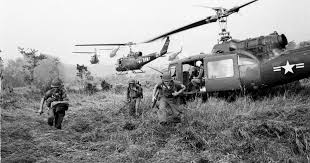
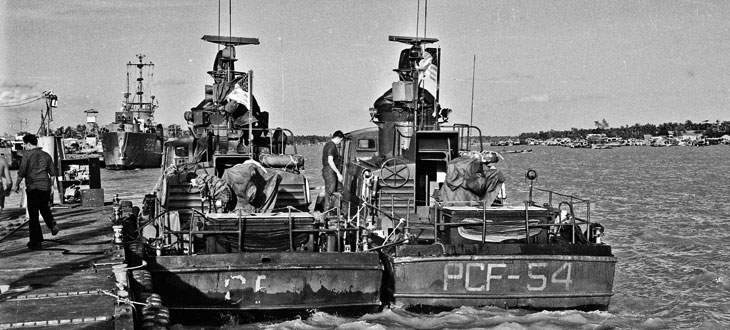
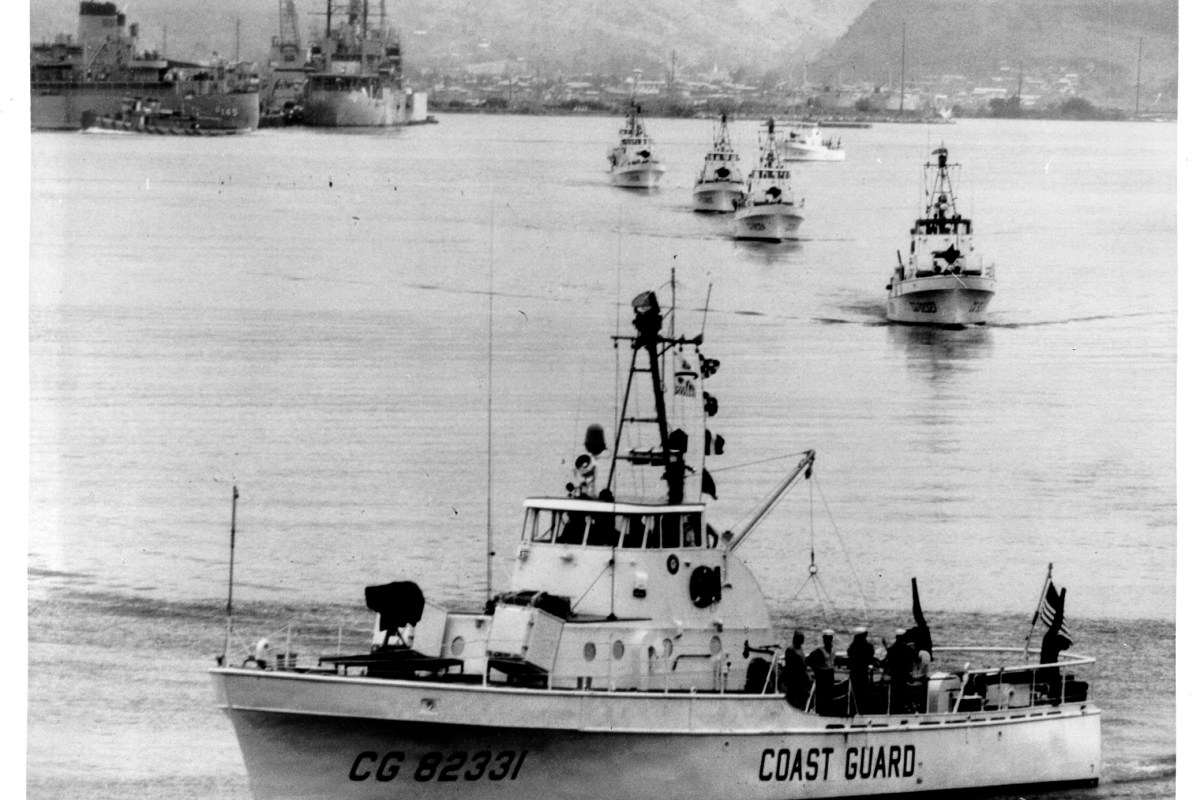

 Photo: USCG photo. Division 11 of Coast Guard Squadron One departs Subic Bay Naval Base for Vietnam, 17 July 1965. USCGC Point Marone (WPB-82331) is in foreground.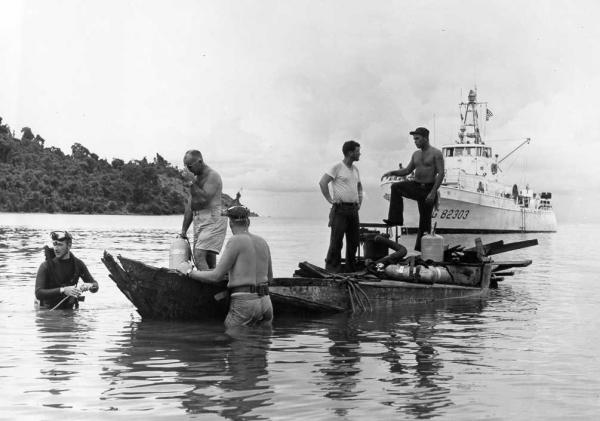



 Nobles Family Blog