Run, Skipper, Run

by Gerald A. McGill

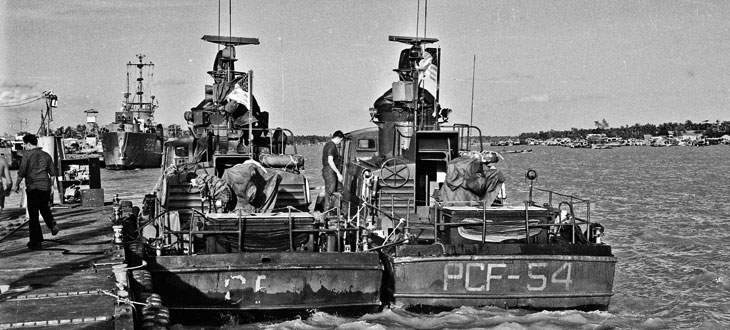
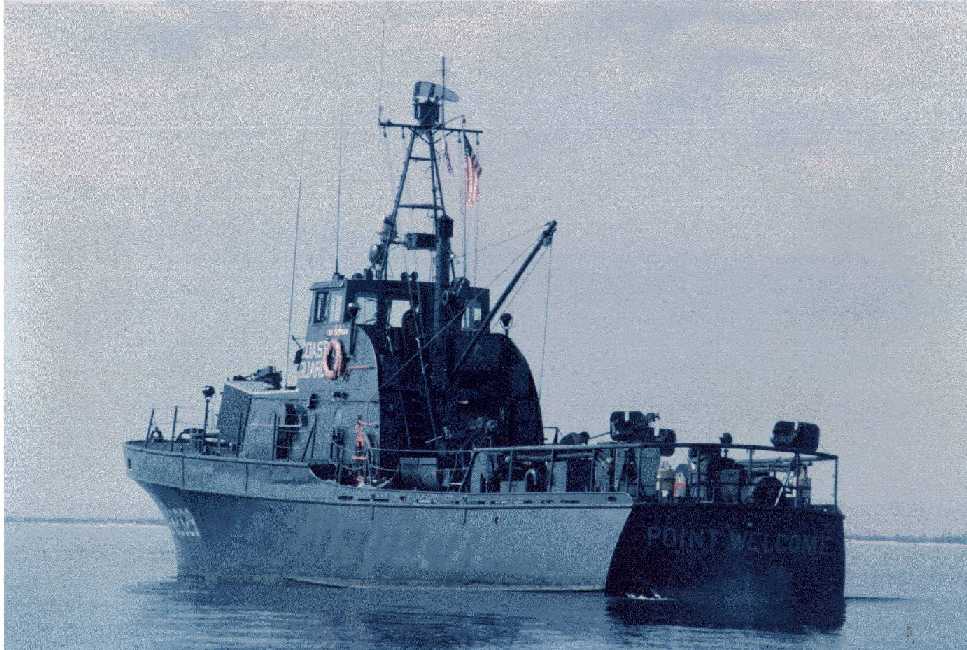
The Point Welcome had just completed a 5 day patrol in area 3B just off the coast near Qui Nhon.  Rather than make the longer trip back to Danang, we moored at the U.S.N. Swift boat base located on the north shore of the harbor.  It was January 30, 1968 at approximately 1600.  As usual we took on fuel and fresh water.

The harbor at Qui Nhon was a much smaller harbor than Danang.  On the south side of the harbor was the city of Qui Nhon.  On the north shore approximately one mile away was the U.S.N. Swift boat base.

 Rumor had it that the city was an in-country R&R (Rest and Recreation) center for both Viet Cong and South Vietnamese Forces.  The South Vietnamese Forces used it during the day and the VC used it at night.  I don’t know if that was true or not but neither I nor my crew visited the city.

The Swift boat base had an Officer’s Club and an Enlisted men’s Club each complete with a cash bar, pool tables and tables and chairs, many of which were used for playing poker or other card games.

There was a mountain behind the base.  The other side of the mountain was considered VC and NVA territory.

The U.S. Army had a couple of tanks on the city side.  On occasion the tanks would fire Harassment and Interdiction (H&I) rounds over the Swift boat base into the mountain top on our side.  We always worried about a “short round” when they were firing over our heads but we were glad they were there that night.

At about 18:30 after supper, I walked about 100 yards from the pier to the Quonset hut that served as the Officer’s Club and also for the berthing area for Swift boat officers who were not on patrol.

I was in the Quonset hut playing poker with several Swift boat officers.  We were in the back part of the Quonset hut about 150 feet from the front door.  About 19:30 we heard the sounds of small arms and automatic weapons fire.  Then the tanks began firing.  Suddenly the front door was kicked open and a person dressed in all black who appeared to be carrying a weapon burst in.  Thinking it was a bad joke, one of the Navy officers said words to the effect:  “C’mon man, that’s not funny.” And it wasn’t as the man fired two or three shots.  The Swift boat officers ran for their weapons.

I did not have my side arm (a .45 caliber pistol) with me but even if I had, I still felt that I needed to get back to my boat.  I recall that I was winning at poker for a change but when the firing started, we left everything on the cable spool we were using for a table.

Apparently, the VC came over the mountain into the base.  I went out the back door of the Quonset hut and dropped to the beach.  Fortunately the beach was about six feet below the path I took to the Officer’s Club, having been eroded by the waves.

I had played soccer and baseball at the Coast Guard Academy, but I was not noted for my speed. But I am certain this was the fastest 100 yard dash I ever ran.

As I got closer to the boat, I could hear some of my crew yelling “Run, Skipper, Run”.  Apparently they could see me with the night vision glasses.  When they pulled me aboard, I was proud of my crew.  The vessel was blacked out, both engines were running, all mooring lines had been cast off and all the machine guns were manned.  Someone said, “All hands are accounted for.” 

 We turned the boat and headed out into the harbor.  All lines of communication were so overloaded no one could communicate with anyone.

 I made the decision to return to our previous Market Time area in 3B.

We didn’t know at the time that this was the start of the Tet Offensive throughout South Vietnam.
48th Anniversary of Start of Operation Market Time (Reblog)

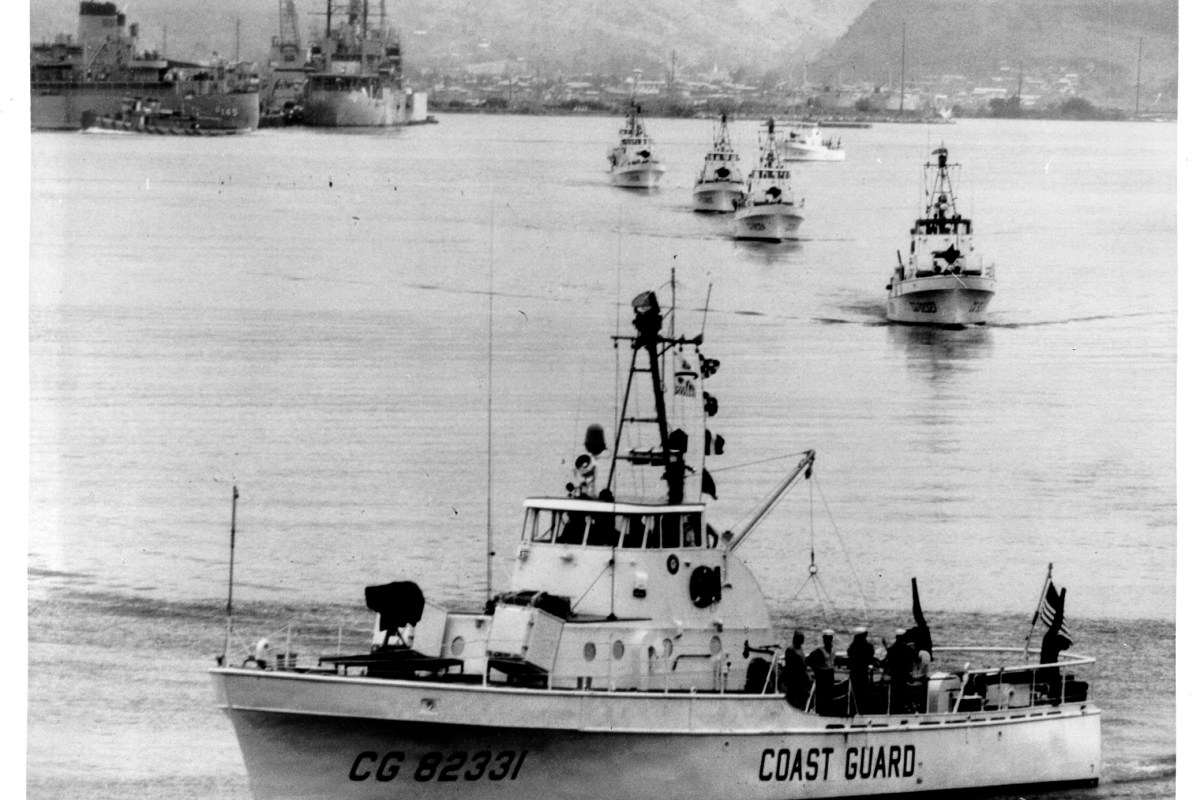
Great photo of the Cutters underway from the Philippines headed to Vietnam (1965).

Chuck Hill's avatarChuck Hill's CG Blog

Photo:  USCG photo. Division 11 of Coast Guard Squadron One departs Subic Bay Naval Base for Vietnam, 17 July 1965. USCGC Point Marone (WPB-82331) is in foreground.
Today is the 48th anniversary of the initiation of Operation Market Time, an experience that would mark a generation of Coast Guard Cuttermen, and provides a template for the sort of operations the Coast Guard might be involved in the future. There is a good history of the Coast Guard’s role in the operation here.

View original post

Operation Market Time

— By Gerald A. McGill

In November 1961, the United States Joint Chiefs of Staff had directed Commander-in-Chief, Pacific (CINCPAC) to look into the South Vietnamese Navy’s poor performance against enemy infiltration into South Vietnam.  CINCPAC, heading up the review team, wanted a Coast Guard perspective. 

Commander John B. Speaker, Jr. from Coast Guard Headquarters in Washington D.C. landed in Saigon on 10 November 1961.  His blunt report to the U.S. Coast Guard Commandant was very unfavorable of the South Vietnamese Navy.  He found ship board maintenance extremely poor, the food bad, and ship board drills and training rarely carried out.  At any time half the South Vietnamese Sea Force could not get underway because of machinery breakdowns.

Prior to returning to Washington D. C., Cdr. Speaker stopped in Honolulu to tell CINCPAC what the Coast Guard could do to help.  One of Speaker’s comments was that if the United States joined in the fighting, Coast Guard cutters were available and were best used in the hands of Coast Guardsmen.

Since the start of fighting in 1960, the U.S. Army in Vietnam contended that most of the supplies reaching the Viet Cong and the North Vietnamese Army in South Vietnam were coming  in by sea.  The U.S. Navy disagreed on the basis of insufficient evidence.  That position changed in February, 1965.

In February, 1965 a U. S. Army helicopter pilot flying a HU-1B Iroquois over Vung Ro Bay near Qui Nhon noticed an “island” moving slowly from one side of the bay to the other.  Upon closer observation, he saw the “island” was a carefully camouflaged ship.  Air strikes were called in and the vessel was sunk.  Intelligence sources determined that ship was North Vietnamese and engaged in supplying enemy forces.

Now the U.S. Navy recognized the need for an effective security and surveillance system.  The Navy also recognized that setting up such a system would be a great challenge.  South Vietnam has 1200 miles of coastline to patrol and an estimate of 60,000 trawlers, junks and sampans to control.

In March, 1965, the Coastal Surveillance Force was established and began Operation Market Time named after the native boats using the waterways for fishing and marketing. This task force provided for a single command to coordinate sea, air and land units of the U.S. Navy and South Vietnamese naval units.

Very soon the U.S. Navy recognized the need for Coast Guard units to support this mission.  On April 29, 1965, President Lyndon Johnson committed to the formation of Coast Guard Squadron One (RON ONE).

Initially 47 officers and 198 enlisted personnel were assigned to RON ONE.  On 16 July, Division 12 of RON ONE departed from Subic Bay, Philippines for Da Nang, Republic of Vietnam.  It arrived on 20 July 1965 and began its security and surveillance patrols on 21 July 1965.

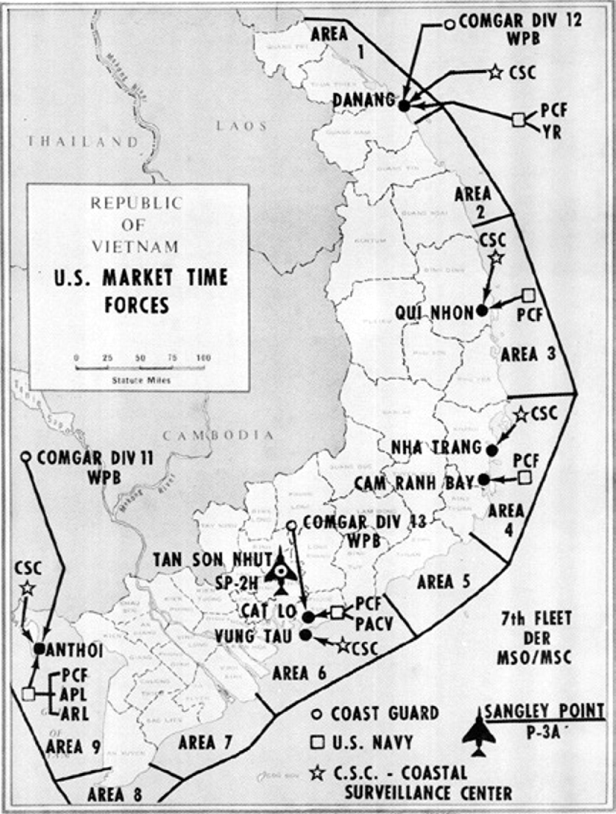
Division 12 consisted of eight 82’ patrol cutters and support staff which had been flown in earlier.  The Division 12 patrol areas were from the 17th parallel, which was the Demilitarized Zone (DMZ) separating North from South Vietnam to Qui Nhon approximately 400 miles to the South.

 Division 11 patrol areas were from the border of Laos and Cambodia and North Vietnam in the Gulf of Thailand south approximately 400 miles to the mouth of the Mekong River Delta south of Saigon.  Division 11 had nine 82’ patrol boats assigned to it.

 The Coast Guard’s first combat engagements came on 19 September 1965.  At 22:30, near the Cambodian Border in the Gulf of Thailand, the USCGC Point Marone  (WPB 82321) closed on a 35 foot junk for boarding.  The occupants of the junk responded with small arms fire.  When the encounter was over, nine Viet Cong were dead and one critically wounded.  There were no Coast Guard casualties. 

 At a little after midnight, in the same area, the USCGC Point Glover (WPB 82307) ordered a 24 foot motorized  junk to stop.  The junk reacted by trying to ram the cutter.  The cutter dodged the junk and its crew fired into the junk’s engine.  When the junk went dead in the water, the five suspected Viet Cong aboard jumped overboard.  One was fished from the water by another cutter and taken prisoner.  The others either escaped or drowned.

For the first time, since World War II, the Coast Guard was at war again.

Paint the Cutters!

By Gerald A. McGill

At the time of the first combat encounters in Vietnam, Coast Guard cutters had white hulls.  This had always been true of Coast Guard vessels, large and small.  The main reason for having white hulls is that the primary mission of the Coast Guard is search and rescue of vessels in distress.  In these missions, visibility is desirable.

Soon after the initial combat engagements, however, an order came from Market Time Headquarters that all the WPBs* were to be painted gray.  In retrospect the order made sense but Guardsmen take great pride in their white hulled vessels and at the time many were displeased. Some felt that if they had wanted to go to sea on gray ships, they would have joined the Navy.  But there was no choice given.

Ever resourceful, Coast Guardsmen soon discovered that by adding a couple of tablespoons of black paint to each gallon of Navy gray paint they created a black-gray shade giving the cutter a more menacing appearance and a lot less visibility.  This ended most of the grumbling.

In the United States, the 82s had white hulls and their hull numbers were painted in black for contrast.  All hull numbers consisted of five numbers with the first two numbers 82.  The Point Welcome was 82329.  When the Vietnam cutters were painted “Coast Guard” gray, the numbers were painted the lighter “Navy” gray for contrast.

*WPB – General term for all Coast Guard patrol boats